
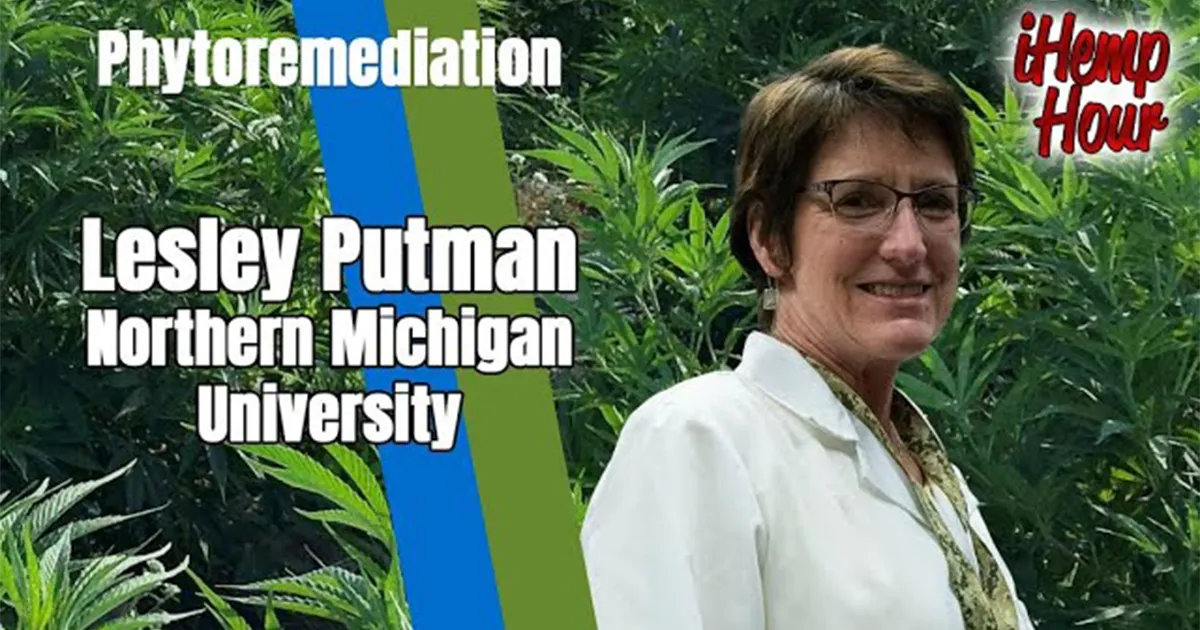
Hemp Takes on Forever Chemicals: Groundbreaking PFAS Research at Northern Michigan University
Dr. Leslie Putnam and Margaret Brum Pioneer Plant-Based Remediation for Michigan’s Contamination Crisis
Industrial hemp’s potential as an environmental cleanup tool is moving from theory to practice in Michigan’s Upper Peninsula. Dr. Leslie Putnam, a researcher at Northern Michigan University (NMU), and Margaret Brum, a chemical engineer and patent lawyer, are conducting pioneering research on using hemp to extract PFAS—the so-called “forever chemicals”—from contaminated soil and water.
Their work represents some of the first above-ground hemp phytoremediation trials in Michigan, with implications for communities across the state grappling with widespread PFAS contamination from military bases, industrial sites, and landfills.
What Are PFAS and Why Should You Care?
PFAS (per- and polyfluoroalkyl substances) are synthetic chemicals that have been used for decades in products we encounter daily—non-stick cookware, waterproof clothing, firefighting foam, and countless industrial applications. The fluorine atoms in these compounds make them incredibly effective at repelling water and grease, but also make them virtually indestructible in nature.
“Anything that’s non-stick or waterproof—that is the chemical that’s used to impart that quality. We’ve all benefited from these chemicals that have made life easier for us, but unfortunately they don’t degrade easily. They’re not degraded in nature in any reasonable time, and they’re finding that they have some health effects.” — Dr. Leslie Putnam
Michigan’s PFAS Problem
The state of Michigan has emerged as a leader in tracking PFAS contamination, maintaining comprehensive maps of affected locations. Key sources include:
- Former military bases (firefighting foam containing PFAS was routinely used near aircraft)
- Industrial facilities (including Wolverine Worldwide’s tannery operations, which recently resulted in a $43 million settlement)
- Landfills (leachate from waste cells often contains elevated PFAS levels)
- Wastewater treatment facilities
“If you go to the state of Michigan website, there are pages and pages on PFAS in the state of Michigan and there’s a comprehensive map of all the locations within the state where they’ve identified a significant amount of PFAS contamination.” — Margaret Brum
The contamination affects not just drinking water but extends to wildlife. State advisories now warn fishermen about consuming freshwater fish, and in some areas, hunters are cautioned against eating the liver and internal organs of deer harvested near contaminated sites.
How Hemp Cleans Contaminated Sites
Phytoremediation—using plants to remove contaminants from soil and water—isn’t new. Dr. Putnam has worked with black locust, little bluestem, and wheatgrass on various contamination projects. But hemp offers unique advantages.
The Science Behind It
Hemp doesn’t actively seek out PFAS. Instead, as the plant draws water from the soil through its root system, it pulls dissolved contaminants along with it.
“It’s because it’s pulling water from the soil. PFAS is in the water, and so it pulls it up with the water.” — Dr. Leslie Putnam
The research has revealed an encouraging finding: PFOS (one of the most toxic PFAS compounds) tends to concentrate in the plant’s roots rather than moving into the leaves and stems.
“The studies that I’ve been doing with PFOS—it mainly stays in the roots. It doesn’t come so much into the leaves. That’s mainly useful for making sure that it doesn’t go down into the groundwater. If you have a contaminated site, to be able to hold it from going into the groundwater is definitely better than having it get in the drinking water.” — Dr. Leslie Putnam
Why Hemp?
Several characteristics make hemp particularly suitable for phytoremediation:
|
Advantage |
Benefit |
|
Fast growth |
Harvestable in 60-70 days |
|
Tolerates poor conditions |
Thrives in non-ideal soils |
|
Deep root system |
Fiber varieties develop extensive taproots |
|
Multiple end uses |
Harvested material can potentially be used in construction materials |
Dr. Putnam’s hydroponic studies found that hemp reached maximum PFAS uptake at around 30 days—meaning rapid cycling is possible for remediation projects.
From Lab to Field: The Research Journey
A Chance Meeting on Lake Superior
The collaboration between Dr. Putnam and Margaret Brum began with a serendipitous encounter aboard a Great Lakes freighter.
“I met her on a Great Lakes freighter a year ago. I didn’t know her, but we started talking. She asked me what my research was on. I told her, ‘Hemp and PFAS.’ I didn’t expect her to know anything about that, but lo and behold she says, ‘Well, I can get you some sludge that contains PFAS.’ My ears perked up.” — Dr. Leslie Putnam
Brum’s knowledge came from practical experience—she had served on the Marquette Area Wastewater Treatment Board, which was dealing with PFAS-contaminated sludge at the former K.I. Sawyer Air Force Base.
Moving Outdoors
Until recently, Dr. Putnam’s research was confined to laboratory hydroponics. That changed dramatically when the first above-ground hemp planting took place on the NMU campus in early July 2023.
“The world has changed because now it’s growing in actual growth medium.” — Margaret Brum
The current greenhouse study uses three European fiber hemp varieties, sourced through Konopius (a connection made through James Decker):
- Earlina (AFC)
- Santhica 70
- USO 31
Plants are grown in four-inch pots for approximately 10 weeks, with treatment periods lasting about one month. The first harvest of the Earlina variety was scheduled for the day after this recording.
The Bigger Picture: Practical Applications
A Hybrid Treatment Approach
Margaret Brum, drawing on her chemical engineering background, envisions hemp as part of an integrated treatment system rather than a standalone solution.
The Marquette Solid Waste Management Authority is currently under a consent agreement with Michigan to reduce PFAS in their landfill leachate. Their chosen method—activated carbon filtration—carries a price tag of:
- 💰 $8 million initial investment
- 💰 $800,000+ annual maintenance costs
Brum proposes a more cost-effective approach:
“Rather than saying you don’t need the activated carbon, you could do pre-treatment of the leachate through a greenhouse full of hemp, and you can do post-treatment of the leachate again through a greenhouse full of hemp. You’d reduce the amount of heavy-duty chemical removal that you have to do.” — Margaret Brum
Hemp in Construction Materials
One intriguing possibility is locking PFAS into hemp building materials like hempcrete. Dr. Putnam believes this could be a viable approach:
“If it pulls up contaminants and then you can still use it for making whatever you want—textiles, hempcrete, whatever—then that’s a good way to do the phytoremediation: to end up with something that’s useful.” — Dr. Leslie Putnam
Importantly, PFAS compounds are not volatile, meaning they won’t off-gas from construction materials:
“It’s not a volatile compound. I would feel pretty confident that it’s stuck in there, especially if it’s some kind of a polymer or even hempcrete.” — Dr. Leslie Putnam
The Good News: PFAS Levels Are Declining
While the scope of contamination is daunting, there’s reason for optimism. PFOS, the most toxic of the PFAS compounds, is no longer being manufactured.
“We all have PFAS in our blood—I hate to tell you, but that’s the way it is. But they’ve actually been measuring that, and it’s been going down since they quit making PFOS. Because they stopped making it, it is decreasing.” — Dr. Leslie Putnam
Research Partnerships and Next Steps
Connecting with State Regulators
Molly Mott, Michigan’s Hemp Program Director at MDARD, has been informed of the research and has already allocated speaking time for Dr. Putnam at a conference this November.
A Growing Research Network
Dr. Putnam’s work is part of an emerging field. She noted a newly formed consortium including:
- University of Maine/Penobscot Nation (working on a former Air Force base)
- University of Minnesota
- Yale University
- National Institute of Environmental Health
This multi-year funded study is exploring the use of nanoparticles to enhance hemp phytoremediation—representing the cutting edge of the field.
The Importance of Certified Testing
One challenge facing the research is the cost of certified PFAS testing—$300-$575 per sample—required by the state of Michigan. The team is working to coordinate with approved laboratories and secure funding for external verification of their results.
How You Can Support This Research
Dr. Putnam and Margaret Brum identified their primary need: funding for certified laboratory testing to validate their findings.
“Money solves all problems usually. We’re trying to send samples out to verify Dr. Putnam’s testing to a certified PFAS lab because the state of Michigan requires the PFAS testing to be done by a certified lab.” — Margaret Brum
If you’re interested in supporting this groundbreaking work or learning more, reach out to Northern Michigan University’s Medicinal Plant Chemistry Program, which has provided the sophisticated analytical instruments making this research possible.
Industry News Roundup
Cannabis Market Update
Mike Brennan reported on Michigan’s cannabis industry:
- 📈 June 2023 sales hit $260 million—a new monthly record
- 📊 Michigan is on track for potentially $3 billion in annual sales
- 💵 Tax revenue of approximately $160 million per billion in sales benefits state and local governments
- 👔 Michigan has ended cannabis testing for some state job applicants due to recruitment challenges
- ⚖️ Federal cannabis prisoners have dropped 61% between 2013-2018
Hemp Advocacy Updates
Dave Crabill highlighted several developments:
- 🏠 Canary Homes Project (via Hemp for Humanity – h4h.earth) is progressing toward groundbreaking this year, creating healthy housing for individuals with severe chemical sensitivities using hempcrete construction
- 🏛️ Jonathan Miller of the U.S. Hemp Roundtable is scheduled to speak at Congressional hearings on July 27th regarding FDA’s failure to establish a regulatory pathway for CBD
- 📝 The Hemp Access and Consumer Safety Act, introduced by Senators Ron Wyden, Rand Paul, and Jeff Merkley, aims to address regulatory gaps
Upcoming Tours
iHemp Michigan is planning fall tours including a visit to a hemp and tire construction project in Fennville (conveniently located near a winery!).
Get Involved
📍 Visit Northern Michigan University – Dr. Putnam and Margaret Brum welcome visitors to tour their research facilities and farm
🌐 Support Hemp Advocacy – Sign up at hempsupporter.com to contact your representatives about hemp legislation
🏠 Canary Homes Project – Learn more at h4h.earth
💚 Join iHemp Michigan – Become a member at iHempMichigan.com to support hemp industry development
Growing the future from seeds of the past.