Midwest Hemp Research Collaborative Secures $700K for Grain and Fiber Trials—And They’re Looking for Michigan Growers
University researchers announce three-year on-farm research project seeking experienced hemp producers across four states
The industrial hemp industry just got a major boost. Researchers from Michigan State University, the University of Wisconsin-Madison, Purdue University, and the Michael Fields Agricultural Institute have secured approximately $700,000 in federal funding to conduct grain and fiber hemp research over the next three years—and they need experienced growers to participate.
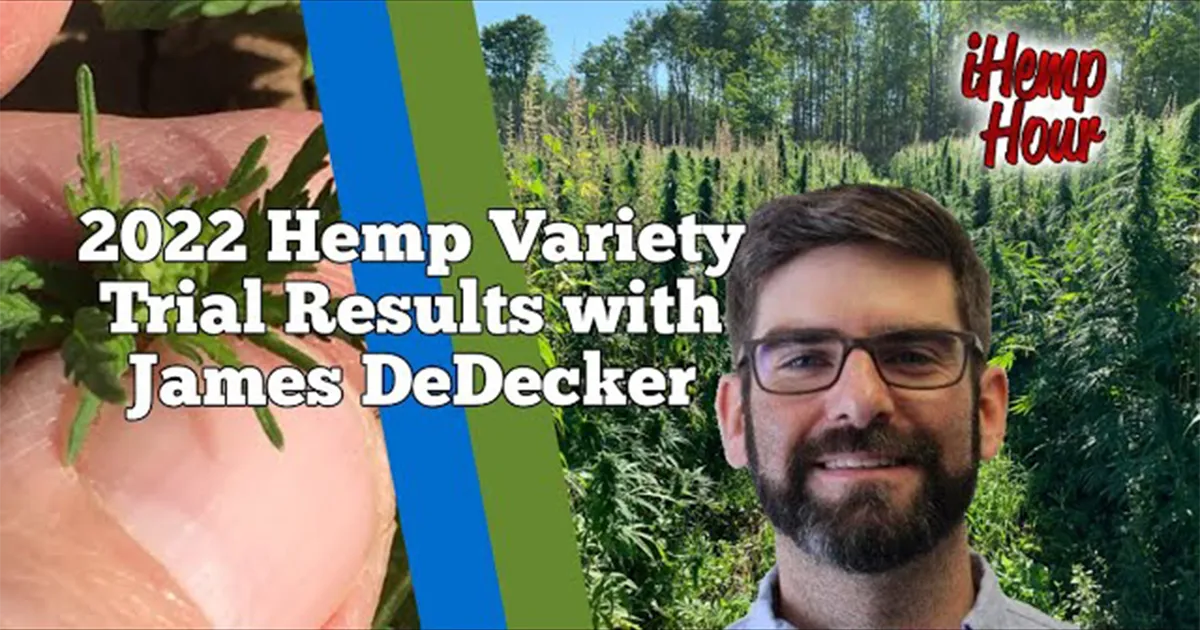
On the December 1st episode of iHemp Hour, James DeDecker, Director of MSU’s Upper Peninsula Research and Extension Center, and Philip Alberti, Research Program Manager at UW-Madison, shared details about the grant, the ongoing variety trials, and the hemp database that’s becoming an essential tool for performance-based testing advocacy.
A $700K Investment in Midwest Hemp
The funding comes from the NIFA Supplemental and Alternative Crops Program, which expanded this year to include hemp alongside canola. The grant will support collaborative research across Michigan, Indiana, Illinois, and Wisconsin, with a significant on-farm component.
“We’re looking for grain and fiber hemp producers to collaborate by conducting simplified variety trials on their land,” DeDecker explained. “We would be supplying the varieties—the seed—for those growers. There’s stipends available in our budget to facilitate them conducting that work and their land costs.”
What the Project Needs from Growers:
- 5 research collaborators per state (20 total across Michigan, Indiana, Illinois, and Wisconsin)
- Experience with hemp preferred—researchers want growers who understand the crop’s challenges
- Commitment to data collection—basic observations on flowering dates, pest incidents, and yield
- Advisory committee participation—1-2 growers per state will help guide research direction
- Plot size: Approximately 5-10 acres to accommodate 5 cultivars with 3-4 replications
The project will evaluate 20+ cultivars in university trials, with growers planting a subset of five varieties (either grain OR fiber, based on their experience and interest). A $1,000 stipend is available per grower to help offset costs.
“Our dream scenario is a hemp grower who’s already paid for the license with the intent of already growing, and we can find a way to have a value-added component to their work,” Alberti noted.
Interested Michigan growers should contact:
- Philip Alberti: palberti@wisc.edu
- Visit the Midwestern Hemp Database website for updates and contact forms
Lessons from the Field: Seed Bed Prep Matters
The 2022 growing season offered valuable insights for grain and fiber producers. DeDecker shared how an experiment with seed bed preparation at MSU’s Upper Peninsula site produced surprising results.
“When I talked to researchers on our team elsewhere, establishment of direct-seeded grain and fiber hemp continues to be a challenge for folks… We’re seeing 50% stand establishment. That’s been about what we’ve achieved here in the past too—we plant twice as many seeds as we get plants.”
This year, MSU tried packing the seed bed before drilling—compacting the soil after tillage to improve seed-to-soil contact. The results were mixed:
|
Metric |
Previous Years |
2022 (Packed Seed Bed) |
|
Stand Establishment |
~50% |
Above 50% ✓ |
|
Plant Height |
70+ inches |
56 inches |
|
Fiber Yield (Unretted) |
8,000-9,000 lbs/acre |
7,200 lbs/acre |
|
Fiber Yield (Retted) |
— |
4,500 lbs/acre |
“Just because we got more plants doesn’t mean that we had higher yields,” DeDecker observed. “The plants struggled a bit in that heavily disturbed and compacted soil once they were established.”
The takeaway for growers: seeding depth may be more critical than seed-to-soil contact, particularly with the variable seed sizes common in today’s hemp market.
The Seed Quality Challenge
Both researchers emphasized that seed quality remains a significant hurdle for the industry. Unlike established commodity crops, hemp seed varies dramatically in germination rates and size.
“Seed quality is all over the place,” Alberti said. “Targeted populations can vary according to seed or fiber production… We’ve really been playing with trying to mess with these targeted populations using pure live seed to account for seed quality.”
How Growers Can Adapt:
- Check germination rates on seed labels (or conduct your own germ test)
- Calculate thousand kernel weight to determine average seed size
- Adjust seeding rates based on pure live seed calculations rather than simple pounds-per-acre
- Account for dormancy which can affect establishment
The research collaborative has remained open to seed from various suppliers—not just certified sources—to evaluate the full range of genetics available to growers.
“We want to look at everything and say, ‘All right, what’s good, what’s bad,’” DeDecker explained. “Without everything’s protected right now, so it’s kind of a blank slate for a lot of this material.”
The Hemp Database: Building the Case for Performance-Based Testing
One of the most significant developments for the industry is the Midwestern Hemp Database, a public repository of variety performance data that could eventually support performance-based sampling—allowing certain proven varieties to be exempt from mandatory THC compliance testing.
What’s in the Database:
Cannabinoid Hemp (High CBD):
- Over 2,000 cannabinoid samples
- More than 200 varieties evaluated
- Some varieties have 100+ samples tested
- Data includes total CBD, THC, compliance rates, and agronomic performance
- Fully updated through 2022
Grain and Fiber:
- Cannabinoid data mostly current through 2021
- Major updates coming in the next few months
- Working toward 95% confidence intervals for compliance
“If we can submit our samples through a USDA DEA lab and have that be fed directly into the database moving forward, that really strengthens the utility of what we have been building,” Alberti said.
The Cultivar Check Program
Through SARE (Sustainable Agriculture Research and Education) partnership grants, the team has been sending promising genetics to grower cooperators across the Midwest. Over two years:
- 32 grower cooperators participated
- 20 different varieties evaluated
- Growers collected cannabinoid samples at 3, 5, and 7 weeks after flowering
- Data used to develop harvest/compliance timelines for each genetic
“Ultimately, a variety gets broken down into: it was compliant through week three, or it was compliant through week five, or compliant through week seven,” Alberti explained. “This allows growers to develop harvest strategies for some of these cultivars.”
Why Performance-Based Testing Matters
The researchers made a compelling case for using variety trial data to inform regulatory policy—potentially eliminating testing requirements for proven low-THC varieties.
“We have seen cases of cultivars that are intended for grain and fiber use that do go over the threshold,” DeDecker acknowledged. “It may be not every plant or every rep that we have in the field, but it does happen. So I think using this database approach is actually a little bit more precise.”
Even a modest increase in the THC threshold—from 0.3% to 0.5% or 1.0%—would dramatically change compliance outcomes.
“It’s such a small change, but it makes a tremendous difference,” Alberti noted. “For high cannabinoid hemp cultivars, it would give growers so much more flexibility and freedom in terms of compliance.”
And there’s a regulatory efficiency argument too:
“If MDARD or state departments of ag are visiting fewer fields, that just reduces their overall cost for administering the program,” DeDecker added. “Maybe you would see our license fees come down.”
2022 Fiber Varieties Tested
For growers interested in what genetics are being evaluated, here’s the fiber variety list from 2022:
|
Variety |
Origin/Supplier |
|
Fibror 79 |
European (Hemp Point/Konopius) |
|
Futura 83 |
European |
|
Futura 75 |
European |
|
Santhica 70 |
European |
|
Monoica |
European |
|
Carmagnola |
European |
|
Nectarol |
European |
|
USO 31 |
Labretsky |
|
Orion 33 |
— |
Most European material is coming through Hemp Point and Konopius, both featured in previous iHemp Hour episodes.
The Research Agenda: What’s Being Studied
Beyond variety trials, the three-year project will investigate critical agronomic questions:
- Seed bed preparation methods and their effects on establishment
- Seeding rates to improve stand establishment
- Nitrogen fertility and implications for yield and quality
- Planting date studies across the full spring window
- Pest observations and diagnostics through UIUC’s Plant Clinic
- Standardized cannabinoid analysis through the USDA lab in Peoria, Illinois
“For the first time, the whole group will be running all of our cannabinoid analysis and grain quality analysis through the USDA lab in Peoria, Illinois,” DeDecker announced. “I think this will be a step toward really harmonizing and standardizing our approach.”
Looking Ahead: Hemp’s Climate-Smart Potential
The researchers noted that federal funding priorities are increasingly focused on climate change mitigation—and hemp fits that narrative well.
“Are we trying to make hemp a climate-smart commodity? Are we trying to improve soil and water quality, capture and sequester carbon in the process of growing this crop?” DeDecker asked. “How we grow the crop, what varieties we select will also differ dependent on those objectives.”
Alberti highlighted an exciting project in Illinois:
“There’s a really exciting project that’s building right now in Lake Decatur, where they’re looking at planting hemp as one of their options for cleaning up some of the sediment and improving water quality.”
Other research directions include phytoremediation of heavy metals in urban soils—potentially creating useful byproducts from contaminated land cleanup.
Upcoming Events & Resources
📅 December 8, 2022 | 6:00 PM Illinois Hemp Growers Association Membership Meeting In-person and virtual attendance available (free registration) Featuring: Legislative updates, Tiger Fiber introduction with co-founder James Forbes, raffles
📅 December 10, 2022 iHemp Michigan Hempcrete Get-Together Location: Grow Green (near Whitmore Lake/Ann Arbor area) Hands-on hempcrete experience—details via iHemp Michigan email list
📅 December 15, 2022 iHemp Hour: Lori Putt & Andrew from HOH Northern Michigan growers discuss international expansion and their award-winning Gracie’s Balm (equine topical) and Gracie’s Calm (1200mg CBD equine elixir)
📅 Late March 2023 (26th) NoCo Hemp Expo Location: The Broadmoor, Colorado Springs, CO
How to Get Involved
To participate in the research project:
- Contact Philip Alberti: palberti@wisc.edu
- Contact James DeDecker through MSU’s Upper Peninsula Research and Extension Center
- Watch the Midwestern Hemp Database website for application information
To explore the Hemp Database:
- Visit the Midwestern Hemp Database (link available through research partners)
- Interact with cannabinoid and grain/fiber variety performance data
- Access compliance timelines for high-cannabinoid varieties
To join iHemp Michigan:
- Visit iHempMichigan.com
- Annual membership: $100/year (includes business directory listing)
- Get on the email list for event invitations and industry updates
The Bottom Line
The Midwestern Hemp Research Collaborative represents exactly what the industrial hemp industry needs: rigorous, multi-state, university-backed research that generates data growers can use and regulators can trust. With $700,000 in federal funding and a call for experienced grower cooperators, this is an opportunity for Michigan producers to shape the future of hemp agriculture.
“There’s something about people who are working in hemp—it’s been a joy to work with this group,” Alberti reflected. “It’s been a career highlight for me to do this work, and to keep doing it is a privilege.”
The sentiment was echoed throughout the conversation: researchers need growers, growers need data, and the industry needs both working together. If you’ve got hemp experience and land to contribute, this is your invitation to be part of building something lasting.
Growing the future from seeds of the past.