Building Sustainable Communities from the Ground Up: Hemp for Humanity’s Vision for Detroit
Cody Ley shares his journey from CBG cultivation to hemp building materials—and a 20-home renewable community project in the Motor City
The industrial hemp industry stands at a crossroads. While CBD markets have cooled and fiber infrastructure remains sparse, a new generation of hemp entrepreneurs is charting a different course—one that connects sustainable agriculture directly to community development. Cody Ley, founder of Hemp for Humanity (H4H) and Regional Seven Leader for the US Hemp Building Association (USHBA), is doing exactly that from his base in Ann Arbor, Michigan.
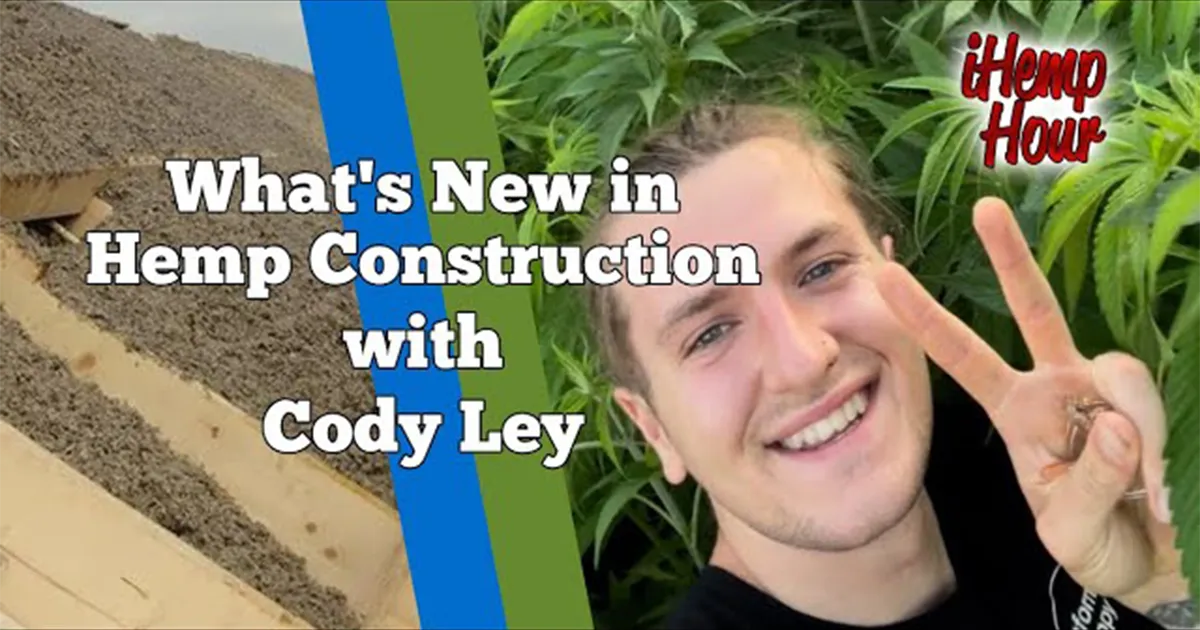
On a recent episode of the iHemp Hour, Ley joined hosts Dave Crabill and Blaine Bechtold to discuss his ambitious “Renewable Detroit” project, the science behind hemp building materials, and why CBG might be the cannabinoid you’re missing.
From Bioplastics Research to Hemp Farming
Ley’s path to hemp wasn’t accidental. As an undergraduate studying environmental science and biochemistry, his senior research focused on plasticizers—the compounds that give plastics their properties—and how they affect soil microbiomes.
“I was studying how these plasticizers were affecting the microbe health… if the plasticizers were toxic, they would be killing the microbes that were supposed to be biodegrading the plastic, defeating the whole purpose.”
This research led him down the hemp rabbit hole, discovering the plant’s potential as a biopolymer replacement. When he graduated in 2020, Ley made a strategic decision: start with farming.
“I realized seeing the industry as it was growing that the biggest problem people were running into was supply… I figured I would start from the farm and that’s really the only way to sustainably build any industry because they’re the foundation of our entire society.”
His first farm operation, located in southwest Michigan near Three Rivers, initially focused on high-CBG varieties. The team grew, extracted, and formulated their own supplements—building revenue while learning the agricultural fundamentals they’d need for their ultimate goal: hemp building materials.
Renewable Detroit: A 20-Home Proof of Concept
The centerpiece of Hemp for Humanity’s work is Renewable Detroit, an ambitious project to build 20 affordable homes (500-600 square feet each) using hemp-based materials in partnership with the Detroit Land Bank.
The numbers tell a compelling story:
|
Project Element |
Specification |
|
Number of homes |
20 |
|
Home size |
500-600 sq ft |
|
Hemp required |
~100 acres |
|
Target farmers |
Underserved small producers |
|
Timeline |
Processing next summer, construction the following year |
“I want to build sustainable communities, and when we talk about building sustainable communities, we have to look beyond just the materials we’re using, beyond the supply chains, and into the communities that we’re actually trying to support.”
Ley emphasized that the project isn’t just about housing—it’s about empowerment:
“It’s one thing to empower people by giving them shelter, energy, and food—they’re basic human rights. But it’s a whole other scenario if you can give communities the tools to cultivate that themselves and build their own community from within.”
For Detroit specifically, there’s historical resonance. The city that was once one of the world’s largest manufacturing centers has an opportunity to rebuild around a new industry.
“For them to have an opportunity to take this brand new industry and rebuild their own city from the ground up into a potential industrial manufacturing center for hemp… that could be extremely moving.”
Solving the Thermal Bridging Problem
One of the technical challenges Ley’s team is tackling involves thermal bridging—a phenomenon that can undermine the insulation benefits of hempcrete walls.
What is thermal bridging? When structural framing (studs, headers, plates) passes through an insulated wall, these denser materials conduct heat more readily than the surrounding hempcrete, creating “bridges” for temperature transfer that reduce overall wall performance.
“Wherever you have your hempcrete, obviously you have a great R-value due to the air pockets inside that hemp wall… any super high-density breaks that you have in your structure will allow heat or any temperature to move through easier than it would through your wall.”
The solution lies in design innovation. While foam or polyurethane materials can address the issue, Ley is focused on finding non-toxic, sustainable alternatives—keeping the entire wall system aligned with hemp’s environmental benefits.
The Magnesium Oxide Solution
For prefabricated panels, magnesium oxide (MgO) boards are emerging as a game-changer:
- Acts similarly to drywall but is breathable (critical for hempcrete walls)
- More sustainable than traditional gypsum-based drywall
- Provides exterior support for panelized systems
- Can also be used as a binder, avoiding the dust and caustic properties of lime
“Using that magnesium oxide in your binder is also very helpful because then you don’t have to deal with the dust and the caustic properties of that lime binder before you mix it with water.”
For interior finishes, Ley recommends natural breathable paints—oil-based options like linseed oil work well, though they’re pricier. The key rule: avoid latex paints that create vapor barriers and compromise the wall’s moisture-management capabilities.
The Economic Potential: What Michigan’s Hemp Industry Could Become
Ley presented a vision that should make policymakers take notice. Michigan currently grows approximately 2.5 million acres of corn and 2.5 million acres of soybeans, representing a combined $4.5 billion agricultural industry.
“If we take that two-year rotation and turn it into a three-year rotation with hemp, then we’re looking at a million acres of hemp on that third year.”
What could a million acres of hemp produce?
- 200,000 homes worth of building materials
- Biofuel energy to power 500,000 homes
- A potential $1-2 billion industry on its own
“If we had 100 acres and we did a full feasibility study from the seed all the way to the building and we show here’s the economic impact… then I think that’s how we really start to gain support and subsidies for the actual hemp agriculture side.”
The project aims to demonstrate what’s possible—creating proof points for mortgages, insurance, and the financing structures that would make hemp homes accessible to everyday families.
Variety Trials: Finding the Right Hemp for Building
When asked which hemp varieties work best for hemp-lime construction, Ley acknowledged the industry is still learning, but shared insights from his trials comparing Asian and European varieties at different planting densities:
European Varieties (e.g., Bialobrzeskie)
- More fiber-dominant at higher densities
- Better suited for fiber production
Asian Varieties
- Grow taller with stockier stalks
- Better for hurd production—the woody core material essential for hempcrete
- Perform best at lower plant populations
“When we’re talking about building with hemp-lime, we want that hurd… you want to be on the lower end of your populations and growing taller, stockier varieties rather than the oil seed varieties.”
Michigan’s Unexpected Advantage: Remediation-Friendly Regulations
While Michigan hasn’t provided the subsidies or state support seen in places like Pennsylvania (which announced $200,000 in matching funds for hemp marketing and promotion), Ley noted one area where Michigan’s regulations are surprisingly farmer-friendly: crop remediation.
“We had two acres test hot this year, and if that would happen in California, I know a couple guys out there that had to bury their whole crop—no chance. Fortunately in Michigan, there’s remediation techniques where you can grind up your biomass, send a representative sample back for testing.”
When remediated material tests non-detected for THC, farmers can keep their crop—a significant difference from states with zero-tolerance destruction policies.
CBG: The “Mother Cannabinoid” for Focus and Energy
Beyond building materials, Hemp for Humanity produces CBG (cannabigerol) supplements—and Ley offered a mini-masterclass on why this cannabinoid deserves attention.
Why CBG is unique:
- It’s the first cannabinoid the plant produces; all others derive from it
- Interacts with both CB1 and CB2 receptor systems (central and peripheral nervous systems)
- Targets the Alpha-2 adrenergic receptor—the same receptor addressed by ADHD medications
“It enhances your focus, your anandamide release, and gives you that real focused, energetic kind of head space while you’re still calm and not jittery in your body. That’s like kind of our motto: calm body, focused mind.”
Dosing recommendations: 20-50 milligrams for most users. Their gummies are formulated at 10mg because they include additional energy-supporting ingredients like B12 and green tea extract.
CBG also shows promising antimicrobial properties—a topic the hosts explored for potential applications in topical products.
Coming This Winter: Hemp Building Education in Michigan
iHemp Michigan announced plans to sponsor educational sessions on hemp building materials throughout the winter months, with Cody Ley and Kim Crows of Fiberfork pLeying key roles.
This initiative connects directly to another exciting project: Jesse’s Castle—an effort to build environmentally safe homes for people with immune deficiencies who react to conventional building materials. The project expects to break ground next spring.
“We’re looking at building what we call safe homes for people… we’re actually got some pretty good legs under this now.”
Industry News Highlights
Pennsylvania Leads on Hemp Support
The Pennsylvania Department of Agriculture announced $200,000 in matching funds for non-profit marketing and promotion organizations to increase sales, exports, and consumer awareness of hemp products. Minimum grant amount: $1,000, with preference for projects leveraging public-private partnerships.
Veterans & Cannabis: Michigan Program Approved
Mike Brennan announced that the new CRA Director Brian Hanna has approved a pilot program providing free cannabis to 25 veterans to treat PTSD symptoms, working through the Hero Project nonprofit.
Hemp Feed Coalition Progress
The Hemp Feed Coalition hosted a webinar bringing together key stakeholders to advance the use of hemp in livestock feed—an important step toward broader USDA approval.
Events & Resources
📅 NoCo Hemp Expo March 29-31, 2023 | The Broadmoor, Colorado Springs The 9th annual gathering of the hemp industry’s leading voices.
🌐 Hemp for Humanity Website: h4h.earth Products: CBG gummies, hemp seed oil supplements Building projects and consultations available
🏠 US Hemp Building Association Cody Ley serves as Regional Seven Leader Resources on hempcrete, panelized systems, and code compliance
📺 iHemp Hour New episodes typically every two weeks on Thursdays at noon Next episode: December 1st (post-Thanksgiving)
The Path Forward
The hemp building industry won’t transform Michigan overnight. As Ley acknowledged, the infrastructure isn’t yet in place to support million-acre ambitions. But projects like Renewable Detroit serve a crucial purpose: they create proof points.
When a bank can see energy performance data from a hemp home, mortgages become possible. When an insurance company can review fire ratings and structural testing, policies become available. When legislators can tour a completed community and meet the families living there, subsidies become politically viable.
“If we see that, then why wouldn’t you put the same subsidies on this industry as you do all these other agricultural industries?”
It’s a reasonable question—and one that Michigan will increasingly need to answer as neighboring states race ahead with support programs.
Hemp for Humanity isn’t waiting for permission. They’re building the future, one 600-square-foot home at a time.
Growing the future from seeds of the past.