European Hemp Genetics Come to America: Konopi US Brings Decades of Fiber Expertise to U.S. Growers
Czech hemp pioneer Hannah Gabrilova and partner Robin Destiche share insights on certified seed, fiber processing, and why planning ahead is essential for industrial hemp success
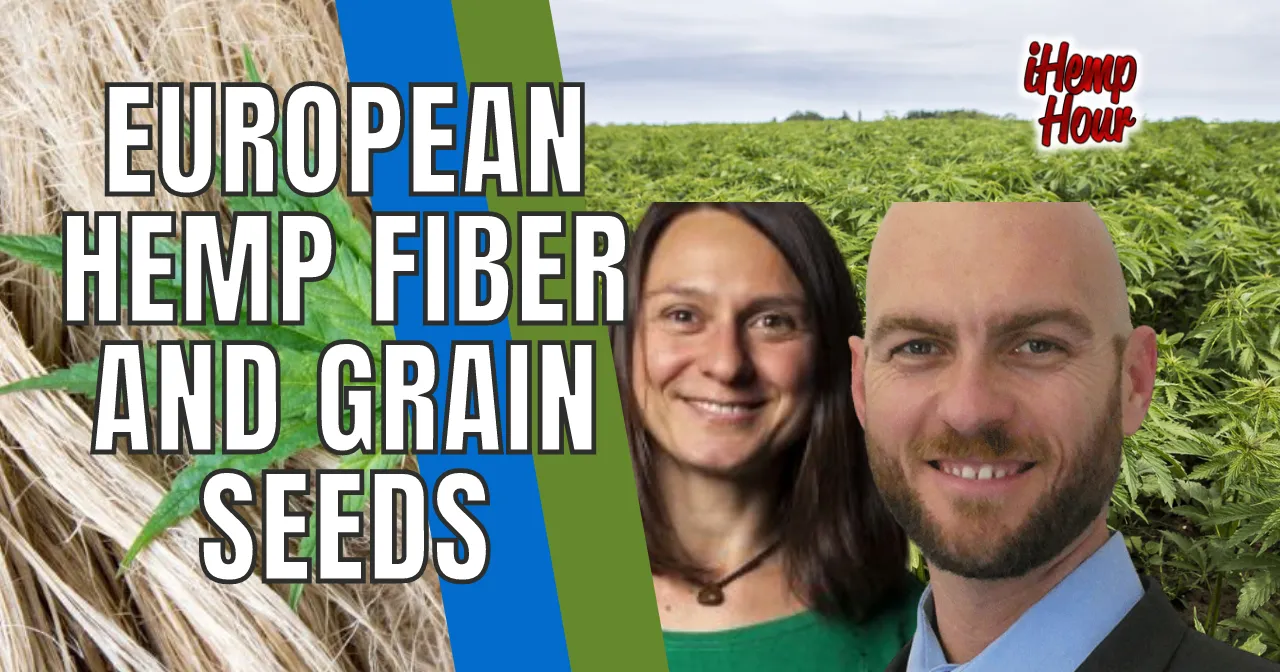
The industrial hemp industry in the United States is still finding its footing—but across the Atlantic, European farmers have been perfecting hemp cultivation for decades. On this week’s iHemp Hour, Robin Destiche and Hannah Gabrilova of Konopi US (and Hemp Point in Europe) joined hosts Dave Crabill, Blaine Bechtold, and Mike Brennan to discuss bringing time-tested European hemp genetics to American soil.
Their message? The foundation of a successful hemp industry starts with the seed—and American growers looking to scale up need to start planning now.
From Nepal to North Carolina: A Partnership Built on Passion for Fiber and Grain
Robin Destiche’s journey into hemp began at a Hemp Industries Association mixer in Los Angeles, but he quickly realized the U.S. market was laser-focused on CBD. His passion lay elsewhere.
“I had always had this passion for the fiber and grain side of the plant, and I couldn’t really find it. I had an opportunity to travel… and really learned that a lot of the fiber and grain activity I was looking for was in Europe.”
Hannah Gabrilova brings over 20 years of hemp experience, starting at an agricultural university in the Czech Republic. She founded Hemp Point in 2010 to distribute certified seeds to European farmers and support them with consulting and food production.
The two crossed paths repeatedly—first at the Asian Hemp Summit in Nepal (which Hannah co-organized with Hemp Today), then at NOCO in Denver, then in Poland.
“It was very clear we had kind of the same rhythm looking at the same way of looking at hemp,” Robin explained. “You don’t meet a lot of foreign travelers looking for hemp in Kathmandu in the fall.”
Their U.S. venture, Konopi US (“konopi” is Czech for hemp), now includes partners Bert James (a North Carolina farmer and hemp agronomist) and Corbett Metsev (with an education background), creating a four-person team focused on seed sales, consulting, farming, processing, and education.
Why European Seed? Consistency, Certification, and Decades of Stability
European hemp varieties offer something American growers desperately need: predictability.
Hannah outlined the key advantages of their seed portfolio:
- Consistency: Seeds come from Europe’s largest breeder, supplying the continent’s biggest growers
- Monoecious varieties: Delivering consistent yields and quality
- OECD certified: Internationally recognized certification allowing legal trade in the U.S.
- EU Catalog listed: All varieties have passed three years of independent government testing, proving stability below 0.2% THC
- High germination: Typically above 90%
- Complete agronomic data: Height, vegetation period, thousand-seed weight, fiber content, oil content—all available in their catalog
“The farmers can really rely on what they will get,” Hannah emphasized. “They are very consistent, and they are all monoecious, which means very consistent yields and quality.”
Some varieties have been on the EU market since the 1960s—proof of their genetic stability over generations.
THC Testing Results Show Promise
Konopi US conducted germination and cannabinoid testing on their 11 varieties this year. The results were encouraging:
|
Variety |
Germination |
Purity |
THC Level |
|
Most varieties |
Mid-90s% |
99.9%+ |
Below 0.2% |
|
Desantica |
90%+ |
99.9% |
Non-detectable |
|
USO |
90%+ |
99.9% |
Non-detectable |
|
Fibrimon |
90%+ |
99.9% |
6% total cannabinoids |
|
Futura |
90%+ |
99.9% |
6% total cannabinoids |
|
Santica 70 |
90%+ |
99.9% |
3.4% CBG |
The surprise CBG content in Santica 70 opens interesting possibilities for dual-cropping—harvesting both fiber and CBG biomass from the same grow.
Banking and Regulations: A Tale of Two Continents
While American hemp businesses still struggle with banking access, European hemp operates as a straightforward commodity crop.
In Europe:
- Licensing cost: Free
- Banking: No problems—hemp is completely legal
- Reporting requirements: Simple announcements when planting begins and harvest totals at year-end
- Farmers receive subsidies for growing catalog-listed varieties
“It costs nothing. It’s for free,” Hannah said of licensing. “The same regulation which applies for the cultivation of poppy applies to hemp.”
In the United States:
- Michigan licensing: $1,350 per year
- Banking: Still problematic—even hemp plastic products can trigger fraud alerts
Blaine Bechtold shared his own recent experience: “I had to send a wire payment, and the lady at the bank said it got marked as fraud going through the banking system. Why? Because it has ‘hemp’ in the name.”
Dave Crabill recalled asking a major bank for a business account for his hemp frisbees. Their response? “They wanted to know how much THC is in the frisbee.”
Seeding Rates and Variety Selection: Matching Purpose to Plant
Different end uses require different approaches to planting density:
For Grain Production
- Europe: 25-30 kg/hectare (approximately 24-32 lbs/acre)
- U.S. recommendation: 25-30 lbs/acre
For Fiber Production
- Standard fiber: ~50 kg/hectare (approximately 56 lbs/acre)
- Textile-quality fiber: 80-85 lbs/acre for thin straw with fine fibers, harvested young
For Hurd (Animal Bedding, Hempcrete)
Allow plants to grow thicker and mature longer to develop more hurd content. However, Robin cautioned:
“You also have to take into account your machine and your decorticator. Can you decorticate a stock that gets this thick? Probably not—you need a chainsaw for this.”
The Decorticator Landscape: Progress Across America
The conversation turned to the critical infrastructure gap: decortication—the process of separating hemp’s valuable bast fiber from its woody core (hurd).
Robin reported several operations now running or coming online:
- Iandy Hemp – Operational
- Melissa (Kansas) – Running
- Biophill (Pennsylvania) – Running
- Texas – Multiple machines planned
- Missouri – Up and running
- Nevada – Coming online
“There’s a big target right now on the hurd, and the hurd is the low-hanging fruit,” Robin noted. “There’s a lot of use for it and it’s the most easily available.”
But what about all that fiber coming off the plant?
Low-Hanging Fruit: Insulation and Animal Bedding
For regions without textile infrastructure, Hannah offered a simpler path forward: hemp insulation.
Unlike hempcrete (which requires cleaner hurd with minimal fiber), hammer-milled hemp insulation uses the entire stem—skipping the costly decortication step entirely.
“The insulation can be very interesting because it’s kind of a final product already,” Hannah explained.
European hemp insulation is created by hammer-milling stems, mixing with flax and PET, then baking into batts. These products offer multiple benefits:
- Longevity: Outlasts polystyrene insulation (which degrades after ~20 years)
- Breathability: Prevents moisture and mold buildup
- Sound insulation: Austria now uses hemp insulation panels for highway sound barriers
- Carbon sequestration: Significant environmental benefits over concrete alternatives
“In Austria, the government is now using these panels from hemp insulation in walls around highways. They realized if they do it thin and put a layer of hemp insulation, they can save a lot of concrete.”
For Michigan specifically, with its automotive industry connections to GM, Ford, and Stellantis (all exploring hemp-based plastics), the hurd market for composite materials represents another accessible entry point.
Planning Ahead: Why Seed Orders Can’t Wait
Perhaps the most critical takeaway for American growers looking to scale: European seed requires advance planning.
The timeline:
- September-October: Seeds harvested in Europe
- October-February: Cleaning, packing, testing, certification
- February-March: Seeds ready and available
- Shipping time: 6-12 weeks (with current global logistics challenges)
“If you’re going to go big, you need to do it in advance,” Robin emphasized. “This year, we were taking orders and payments in October and November for the following year.”
For container-load orders (approximately 800-850 acres of seed per container), payments need to clear months before planting season.
Konopi US can distribute smaller quantities (up to 10-15 tons) domestically from their North Carolina location, but large commercial operations must plan accordingly.
Geographic Considerations: Latitude Matters
Robin presented a latitude comparison showing where European hemp-growing regions align with U.S. geography. The 45th parallel cuts through:
- Europe: Southern France, Northern Italy (major hemp regions)
- U.S.: Northern tier states
This explains why growers in Arizona, Texas, and Southern California often find better success with Chinese or Australian cultivars—genetics adapted to more southerly latitudes.
Current Konopi US Growing States (2022)
The company is working with growers and universities across a broad swath of states, testing which varieties perform best in different climates, soil types, and growing conditions.
2022 Midwest iHemp Expo: Your Next Step
Ready to learn more about hemp fiber, grain, and processing opportunities? The 2022 Midwest iHemp Expo is happening May 20-21 at the Lansing Center.
Pre-Expo Events 📅
Thursday, May 19th
- 🕚 Audit-Ready Training with Pete Nielsen (Analytical Laboratories)
- 💰 $300 (includes lunch)
- Perfect for processors preparing for third-party certification
Thursday Evening, May 19th
- 🏆 Hempies Awards Ceremony following the networking session
- ⏰ Deadline to submit products is NOW
Expo Highlights
- 70+ speakers covering all aspects of the hemp industry
- Friday: Business-to-business focus
- Saturday: Free general admission (some sessions require All-Access Pass)
- Kim Crows demonstrating blown-in hemp insulation with her spray application machine
- Michigan State University presenting variety trial data
Hotel Deal 🏨
Radisson rooms available for $119/night (regular rate ~$200)—deadline is TOMORROW!
👉 Register now at MidwestiHempExpo.com
Resources & Contacts
Konopi US
- 🌐 Website: KonopiUS.com
- 📧 Robin Destiche: robin@hemp.cz
- 📧 Hannah Gabrilova: hunka@hemp.cz
- 💼 Find them on LinkedIn
Hemp Point (Europe)
- Distribution of planting seeds, animal feed, human food, grains, proteins, and dehulled seeds
Recipe of the Week: Hemp and Pecorino Crusted Salmon 🐟
By Brittany Mills
A 12-minute meal that’s gluten-free, low-carb, and loaded with protein!
Ingredients:
- 4-5 salmon fillets (5-6 oz each)
- ½ cup grated Pecorino and Parmesan cheese
- ¼ cup hemp hearts
- 1 tsp dried basil
- 1 tbsp dried parsley
- 1-2 tbsp hemp seed oil
- 1 tbsp lemon juice
- Lemon slices, salt, and pepper to taste
Instructions:
- Combine hemp hearts, cheese, basil, and parsley
- Press mixture onto salmon fillets
- Cook in oven (or on grill) until desired doneness
- Serve with lemon slices
Mark Your Calendar 📅
- May 19: Audit-Ready Training & Hempies Awards (Lansing)
- May 20-21: 2022 Midwest iHemp Expo (Lansing Center)
- May 23: National Turtle Day 🐢 (Are you a Turtle?)
- August 27: 8th Annual Blessing of the Hemp
Note: The iHemp Hour will be on hiatus May 19th and 26th—the team needs a well-deserved rest after the Expo!
The path to a thriving American hemp fiber industry runs through quality genetics, proper infrastructure, and advance planning. With partners like Konopi US bridging decades of European expertise to U.S. soil, Michigan growers have access to the proven varieties they need to succeed.
The question isn’t whether fiber hemp will work in America—it’s whether we’ll be ready when the processing infrastructure catches up.
Growing the future from seeds of the past.