Hemp Seed Varieties for 2022: Expert Jeff Kostuik on Grain, Fiber, and the Future of Hemp Genetics
Veteran hemp breeder Jeff Kostuik of Verve Seed Solutions shares 23 years of experience—from doubling grain yields to why certified seed matters more than ever.
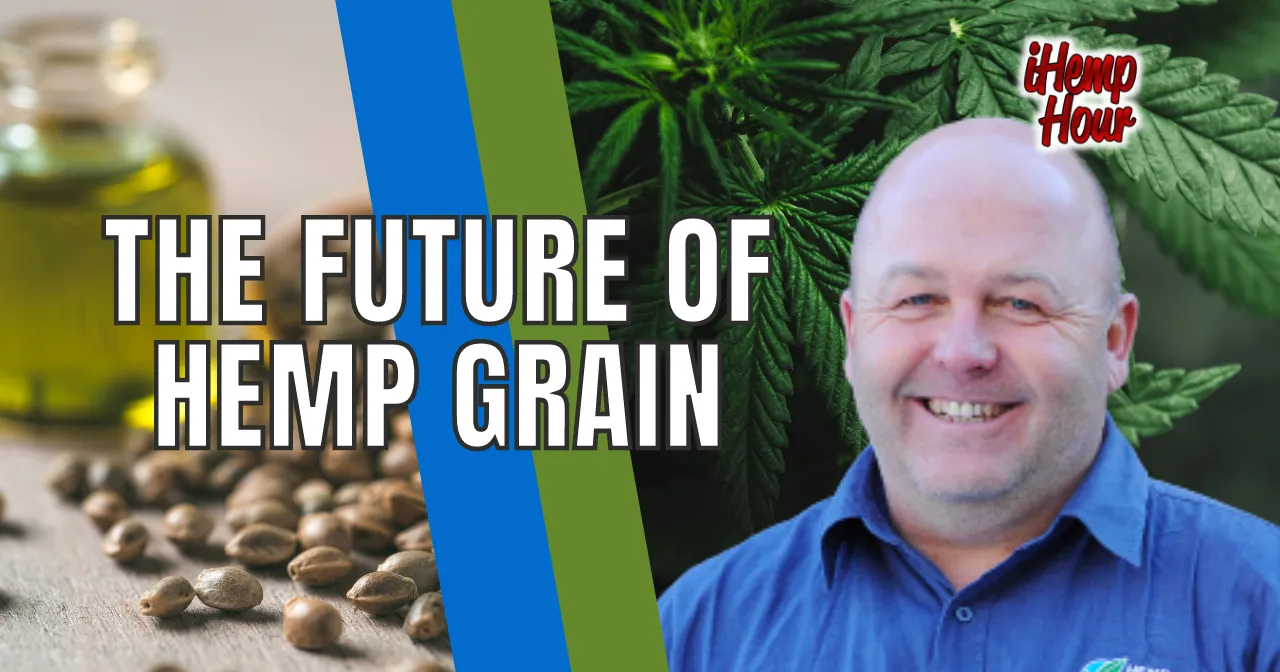
When it comes to growing industrial hemp for grain and fiber, few people have the depth of real-world experience that Jeff Kostuik brings to the table. With 23 years in the hemp industry, a background in pedigreed seed production, and leadership roles with both the Canadian Hemp Trade Alliance and the Hemp Industries Association, Kostuik joins iHemp Hour to discuss what’s working in Canada—and what American farmers can learn as the U.S. hemp industry matures.
Big News: Hemp Genetics International Merges with Tritium to Form Verve Seed Solutions
Kostuik announces a major development: the merger of Hemp Genetics International (HGI) and Tritium (T3H) to form Verve Seed Solutions—a name meaning “spirit, enthusiasm, and vigor.”
“These are some of the smartest minds in the breeding capacity for hemp in North America, perhaps the world, now working towards the same direction,” Kostuik says.
The merger combines:
- HGI’s 24+ years of grain variety development and pedigreed seed production
- Tritium’s molecular breeding capacity and hybrid development expertise
- Licensing agreements with Charlotte’s Web, Arcadia Bioscience, and U.S. Genetics
The Hybrid Hemp Revolution
What excites Kostuik most is the potential for hybrid hemp varieties—a breeding approach that has transformed crops like canola.
“I really feel that within the next two to three years we’re going to be able to double grain production with these varieties and have a much more uniform crop,” he predicts.
For context, Canadian hemp grain yields have already improved dramatically:
- Early days: 300-400 lbs/acre provincial average
- Current average: 800-900 lbs/acre
- Top producers: 1,000-1,500 lbs/acre consistently
- Best years: 2,000 lbs/acre achieved
Compare that to the current U.S. average of approximately 530 lbs/acre—showing the growth potential as American farmers gain experience with the crop.
Available Varieties for 2022
Grain Varieties
Verve Seed Solutions offers several grain varieties suited for northern U.S. latitudes:
- CRS-1 – Proven performer for northern states
- CFX-2 – Another strong option for the upper Midwest
- Indigo (coming soon) – A partial hybrid with a unique purplish tone, good height for harvest, and excellent yield potential
CBD Varieties
For high-cannabinoid production, Verve offers:
- CDF1 – Canada’s first true hybrid high-cannabinoid variety
- Multiple feminized and autoflower options for both orchard-style and broad-acre production
- Varieties from Charlotte’s Web and Arcadia Bioscience licensing agreements
CBD varieties target 10-12% CBD with a 28-30:1 CBD-to-THC ratio to stay within Canadian regulations while maximizing cannabinoid content.
The Canadian Model: What the U.S. Can Learn
No Field Testing Required for Farmers
In Canada, THC testing happens at the pedigree level during certified seed production—not in farmers’ fields.
“If you’re growing the variety for seed production, it gets tested there. When the farmer gets it in his possession, it no longer has to be tested in his field,” Kostuik explains. “I know of no fields in Canada over the last 24 years that have ever had to be destroyed or questioned because they were hot.”
No License Fees
Canadian hemp growers apply for a license at no cost—a stark contrast to Michigan’s $550 registration fee plus $350-400 in testing costs.
“We just need a hemp license, but there’s no cost to it. We just apply for it and you get it,” Kostuik notes.
The Push for Deregulation
The Canadian Hemp Trade Alliance continues advocating to completely deregulate hemp grown for grain or fiber.
“It just doesn’t make a lot of sense at this time,” Kostuik says. “What does it matter if it’s one percent or 0.3 percent THC to build hempcrete or make frisbees or any other kind of bio-composite?”
The Case for Certified Seed
Kostuik makes a compelling argument for why certified seed matters—even when non-certified seed sometimes performs well:
Genetic Stability
“One of the most uniform things about this crop is that it’s non-uniform. The pollen flow is extensive,” he explains. “You run the risk of having seed that tends to go backwards or just does not look the same five or six years down the road.”
Third-Party Verification
Certified seed production requires:
- Breeder seed: No other hemp variety within a 3-5 mile radius
- Third-party inspections at each pedigree level
- Regulations limiting cross-pollination to maintain variety distinctness
Supporting Breeding Programs
“These breeding programs are very small. The revenue created from them is from seed sales,” Kostuik notes. “For us to continue to advance the genetics within the industry, that money has to come back for research.”
The 0.3% vs 1% THC Debate
Kostuik offers a Canadian perspective on the push to raise the U.S. THC limit:
“The gentleman who basically wrote the regulations in Canada… said that was his biggest regret—he just picked an arbitrary number of 0.3 percent,” Kostuik shares.
At 1% THC:
- More varieties become viable
- Farmer risk decreases significantly
- For grain and fiber, the THC level is essentially irrelevant to end-use
However, Kostuik raises an important consideration: raising the field limit to 1% while keeping finished products at 0.3% could create formulation challenges for processors.
Dual-Purpose and Tri-Crop Hemp: Is It Worth It?
When asked about growing hemp for multiple revenue streams (grain, fiber, and CBD), Kostuik offers practical advice:
“Pick one of those revenue streams and do a damn good job at producing that product—then see what you can get for residual.”
His reasoning:
- You won’t get textile-quality fiber if you harvest for grain
- You won’t maximize CBD if you’re using large mechanized equipment
- Different harvest timing optimizes different products
The exception: Fiber and CBD can work together, as you’re harvesting at similar times. Non-woven matting, insulation, and hempcrete don’t require the same fiber quality as textiles.
Infrastructure Challenges: The Decortication Problem
Both Canada and the U.S. face similar challenges with fiber processing infrastructure.
The Problem with Centralized Processing
“Back in the day, I sat through presentations where a company would come in planning to build a $35 million decorticating facility. You’d have to contract 20,000 acres within 100 miles to feed it,” Kostuik recalls. “Moving those bales any distance is the difficult part.”
The Mobile Decortication Solution
Kostuik sees mobile decorticators as the answer:
- Smaller units that can move from farm to farm
- Handle a couple thousand acres each
- Compact the fiber and hurd for more economical shipping
The Retting Knowledge Gap
“The decortication machines are there—machines that’ll do a heck of a job. But the retting process, or controlled rotting… we don’t have a good understanding of how to properly ret this crop,” Kostuik admits.
Retting—where microbes break down the pectin and lignin binding fibers together—varies significantly based on climate, soil, and conditions. More research is needed.
Carbon Credits: A Canadian Farmer’s Experience
Kostuik shares his firsthand experience with carbon credit programs on his farm:
How It Works
He works with Farmer’s Edge, which provides:
- Daily satellite imagery
- Soil testing every second year
- Variable-rate fertilizer prescriptions by field zone
- Weather stations measuring soil moisture
- Disease risk monitoring
The Results
“We put in our yield targets and we’re usually just half a bushel off,” Kostuik says. The precision agriculture approach means:
- More efficient fertilizer use (not necessarily less, but better placed)
- Variable-rate herbicide application
- Environmental sustainability checkmarks
- Carbon credit payments that offset service costs
Cash Incentive Model
Rather than banking credits to sell later, Kostuik receives direct cash incentives while Farmer’s Edge trades the credits. No upfront audit costs—they handle the paperwork.
2022: The Year to Start Learning Hemp
With commodity prices at historic highs—$8-10/bushel corn, $24 canola—Kostuik sees an opportunity:
“This is the year that you want to throw a quarter in, throw some hemp in to start to learn how to grow the crop. Those other crops will help absorb any blowback you get.”
His reasoning:
- Hemp takes about three years to learn to grow well
- High-value traditional crops provide a financial cushion during the learning curve
- Markets are developing, and experienced growers will have an advantage
Michigan Regulatory Update: MRA Becomes CRA
The episode also addresses Michigan’s Executive Order 2021-1, which reorganizes the Marijuana Regulatory Agency (MRA) into the Cannabis Regulatory Agency (CRA).
Key changes:
- Growers remain registered with MDARD (agriculture)
- Processors move to the new CRA
- Anyone processing hemp into CBD products, edibles, or other consumer goods falls under new oversight
iHemp Michigan has submitted formal comments and is forming a working group of processors and retailers to engage proactively with regulators. Director Brisbo will appear on a future iHemp Hour to discuss the changes.
Looking Ahead: Hemp Feed for Livestock
Both Canada and the U.S. are working toward approval for hemp in livestock feed through the Hemp Feed Coalition.
Current status:
- Legal for on-farm use (feeding your own animals for personal consumption)
- Illegal for commercial market in both countries
- Pets and horses (not consumed) have fewer restrictions
- Poultry likely first to gain approval—Canadian trials showed omega transfer into eggs
“When that happens, that’s huge for our industry,” Kostuik emphasizes.
Key Takeaways for Hemp Farmers
- Certified seed matters for genetic stability and supporting breeding research
- Match variety to latitude—northern varieties won’t perform well in the Southeast
- Focus on one revenue stream and optimize for that before chasing dual-purpose dreams
- Start learning now while commodity prices cushion the learning curve
- Carbon credits can work with the right precision agriculture partner
- Mobile decortication may solve the fiber infrastructure bottleneck
- Hemp feed approval is coming—position yourself for that market
Connect with Verve Seed Solutions
The merger is fresh, but seed is available now. Search for:
- Tritium (T3H)
- Hemp Genetics International (HGI)
A new Verve Seed Solutions website is coming soon. For seed inquiries, contact through the existing company sites or reach out to iHemp Michigan for connection.