Hemp Compounds and COVID-19: What the Research Really Shows About CBDA and CBGA
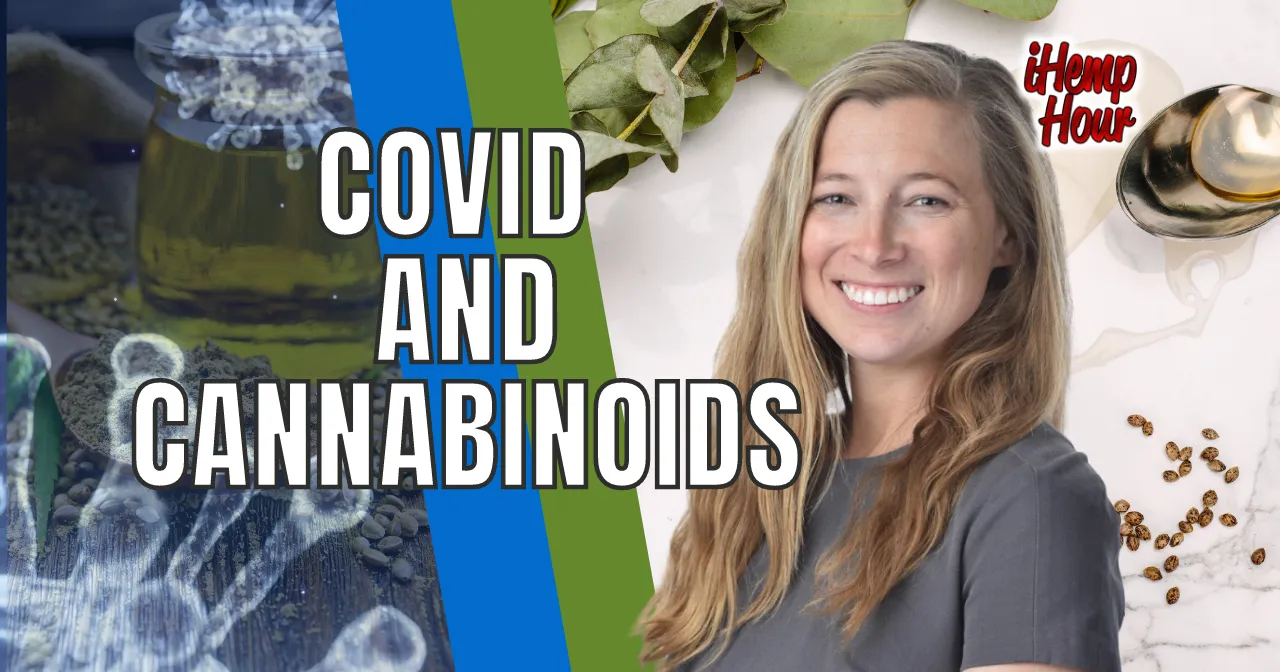
Annie Rouse of Anavi Market joins iHemp Hour to separate fact from hype about the viral Oregon State University study on cannabinoids and coronavirus.
When Oregon State University researchers published their findings that certain hemp compounds could block COVID-19 from entering human cells, the news went viral. Headlines exploded across major media outlets, and suddenly everyone in the hemp industry was fielding questions about cannabinoids and coronavirus.
But what does the research actually show? Is this a breakthrough or just hype? Annie Rouse, cannabinoid formulation expert and founder of Anavi Market, joins iHemp Hour to break down the science, explain what CBDA and CBGA actually do, and offer a reality check on what consumers should—and shouldn’t—expect from hemp products.
The Oregon State University Study: What Researchers Actually Found
In January 2022, researchers at Oregon State University, in collaboration with Oregon Health & Science University, published groundbreaking research in the Journal of Natural Products.
oregonstate.edu
The study, led by Dr. Richard van Breemen, used a chemical screening technique to identify compounds that could bind to the SARS-CoV-2 spike protein.
The key findings:
Two cannabinoid acids—cannabigerolic acid (CBGA) and cannabidiolic acid (CBDA)—were found to bind to the spike protein of the coronavirus.
oregonstate.edu
This is the same drug target used in COVID-19 vaccines and antibody therapies. By binding to the spike protein, these compounds block a critical step in the process the virus uses to infect human cells.
“They looked at a lot of different cannabinoids and they found that CBDA, CBGA, and THCA actually had an affinity to the spike proteins that are found in COVID,” Rouse explains. “If you look at the COVID virus, it’s the little suction cups on a golf ball—the antennas. Those are the spike proteins. It has an affinity towards those and blocks the ACE2 receptors.”
Effectiveness Against Variants
The hemp compounds demonstrated effectiveness against emerging variants of the virus, including the B.1.1.7 (Alpha, first detected in the UK) and B.1.351 (Beta, first detected in South Africa) variants.
eurekalert.org
Not a Controlled Substance
Unlike THC, CBGA and CBDA are not controlled substances and have demonstrated a good safety profile in humans.
horncreekhemp.com
They can be administered orally, making them potentially accessible as a preventative measure.
Understanding CBDA and CBGA: The “Raw” Cannabinoids
Most consumers are familiar with CBD (cannabidiol) and CBG (cannabigerol), but CBDA and CBGA are different compounds entirely—they’re the acidic precursors found in raw, freshly harvested hemp.
“CBDA is actually from the plant—it’s what is produced in the flower,” Rouse explains. “Actually, all cannabinoids stem from CBGA, which is the mother cannabinoid. CBGA converts in the plant into CBDA, THCA, and CBCA.”
Here’s where it gets important: These acidic forms convert to their more familiar counterparts when exposed to heat. This process, called decarboxylation, means that most commercial hemp products—which undergo extraction and processing—contain CBD rather than CBDA.
“Once you take that plant material over heat through extraction methods, or over time, those acid compounds will fall off and convert into what’s more commonly known as CBD,” Rouse notes.
This is why standard CBD products are unlikely to provide the same effects shown in the Oregon State research—you need products specifically formulated to preserve CBDA and CBGA in their acidic forms.
What the Research Does NOT Say
Rouse is quick to temper expectations with scientific reality:
- This Was Laboratory Research, Not Human Trials
“Of course, a lot more research needs to be done on this subject. This was one instance in a controlled environment,” she emphasizes.
The study was conducted in vitro (in test tubes/cell cultures), not in living humans.
- Commercial CBD Products Are Different
The COVID-blocking effects observed in research come from specific cannabinoid acids at specific concentrations.
forbes.com
Standard CBD oils, gummies, and other commercial products typically don’t contain significant amounts of CBDA or CBGA because heat processing converts them.
- It’s a Complement, Not a Replacement for Vaccination
“The paper actually specifically points out that the first line of the paper is ‘when used in conjunction with—as a complement to—vaccines,’” Rouse notes. This research explores an additional layer of protection, not an alternative to established preventive measures.
- Variants Matter
Rouse shares a revealing personal observation:
“A lot of friends and colleagues in the space weren’t getting COVID. We’d go out, we’d see people, and me personally, I was exposed several times—I never got it. Then at the end of this year when the Omicron virus really started coming in hot, I got COVID. My boyfriend got COVID. Like 10 different colleagues I know all got covered.”
Her conclusion?
“I don’t think CBD—it was probably working for the originals—but I don’t think it’s working for this one because there’s been a really high rate of infection now among a lot of people that I work with that all take CBD and hadn’t gotten it and now they’ve all gotten it.”
Additional Research: CBD’s Anti-Inflammatory Potential
Beyond the spike protein research, other studies have explored CBD’s potential role in managing COVID-19 symptoms:
Cytokine Storm Reduction
CBD may help reduce lung damage caused by cytokine storms—the dangerous inflammatory overreaction that makes severe COVID cases so deadly.
cannabissciencetech.com
Research suggests CBD may help turn free radicals into lower active forms, potentially minimizing damage from severe infection.
Viral Replication
Some studies indicate CBD may prevent viral replication in live animals by activating host cell stress responses and generating interferons—antiviral proteins produced by the body.
carolinachiropractors.org
Long COVID Symptoms
Cannabinoids may be helpful in treating lingering symptoms of Long COVID, including anxiety, depression, decreased appetite, pain, and insomnia.
The Bigger Picture: Why This Research Matters for Hemp
This research highlights something the hemp industry has long advocated: cannabinoids beyond just CBD deserve serious scientific attention.
“We’ve been a huge proponent of CBDA since really the beginning of the whole cannabinoid movement,” Rouse shares. “One of my business partners and I had actually—with CBGA being the mother cannabinoid—it was like, ‘Oh, this has got to be like the cannabinoid. I bet it’s like the holy grail.’”
The Oregon State research validates this intuition while reminding everyone that cannabinoid science is still in its early stages.
What Consumers Should Know
CBDA and CBGA Products Are Different from Standard CBD
If you’re specifically interested in the compounds studied in the Oregon State research, look for products explicitly formulated with CBDA and CBGA—not just CBD. These require special processing to preserve the acidic forms.
Heat Destroys Acidic Cannabinoids
“With things like CBDA, you really need lower temperatures so that it doesn’t degrade,” Rouse explains. This affects both manufacturing (hard candies made at 400°F will degrade CBDA) and home use (smoking converts CBDA to CBD).
Quality and Sourcing Matter
Not all hemp products are created equal. Products from reputable sources with third-party testing provide transparency about exactly which cannabinoids—and how much—are actually present.
Clinical Trials Are Needed
Researchers recommend clinical trials to determine whether CBD or its acidic precursors could be used as a preventative or early treatment for COVID-19.
louisville.edu
Until that research is complete, claims should be viewed as preliminary.
The FDA and Regulatory Landscape
Rouse discusses the complicated regulatory environment for cannabinoid products:
“The FDA, unless you’re making pretty bad medical claims, I don’t think really has time to deal with everything given the state of the world right now with COVID,” she notes. “They continuously say that CBD is not a supplement, that the products are illegal—but the cat’s out of the bag. They can’t possibly bring it back in.”
The United Kingdom’s FSA (their equivalent of the FDA) has created a regulatory pathway for CBD products as a “novel food,” with a maximum daily use limit of 70 milligrams for CBD as a supplement. This kind of regulatory clarity is what the U.S. market needs—and what legislation like HR 841 aims to provide.
Beyond COVID: The Many Benefits of Cannabinoids
While the COVID research captures headlines, Rouse emphasizes the broader potential of various cannabinoids:
|
Cannabinoid |
Primary Benefits |
|
CBD |
General wellness, stress support |
|
CBDA |
Anti-inflammatory (COX-2 inhibitor), more bioavailable than CBD |
|
CBG |
Mood support, focus, potential antibacterial properties |
|
CBN |
Sleep aid |
|
THC |
Appetite stimulation (intoxicating) |
“CBDA is actually a very potent anti-inflammatory,” Rouse explains. “It really can be considered an NSAID but doesn’t necessarily have some of the same negative properties that ibuprofen has. It’s considered a COX-2 inhibitor—it binds and kind of stops the inflammation from occurring by inhibiting an enzyme that creates inflammation in the body.”
The Bottom Line: Take Your Cannabinoids, But Keep Perspective
“Have you taken your CBD yet today?” Rouse asks. “I take it every day—take it every morning, take it every night.”
Her recommendation isn’t based on COVID protection alone, but on the broader wellness benefits of cannabinoids. The COVID research is exciting and warrants further study, but it’s one piece of a much larger picture of cannabinoid potential.
The takeaway: The Oregon State research represents promising early-stage science that validates continued investigation into hemp compounds. It does NOT mean that grabbing any CBD product off the shelf will protect you from coronavirus. For those interested in CBDA and CBGA specifically, seek out products formulated to preserve these acidic cannabinoids—and maintain realistic expectations while the science continues to develop.
Where to Find Quality Cannabinoid Products
Annie Rouse recommends checking out:
- HempMellow.com – Full spectrum products maximized for cannabinoid content
- OvercomeEveryday.com – CBD, CBDA, and CBG formulations
- AnaviMarket.com – Multiple brands with CBDA relief products
Or just remember: Think Hempy Thoughts and you’ll find your way there.