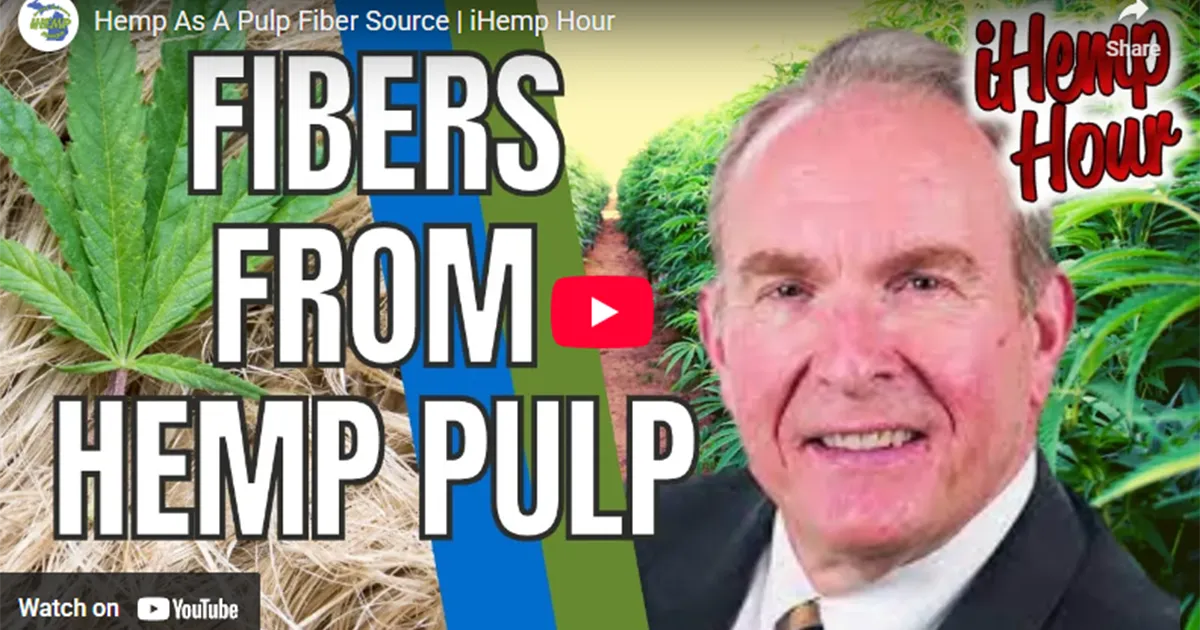
iHemp Hour: The Science of Strength with Dr. Chris Luettgen of Georgia Tech
The dream of a hemp-based economy, with everything from car parts to cardboard boxes made from this versatile plant, is closer than ever. But turning that dream into a reality requires a deep understanding of materials science. In a technically rich episode of the iHemp Hour, the team was joined by Dr. Chris Luettgen, a leading expert from Georgia Tech’s Renewable Bioproducts Institute, to discuss the real-world engineering challenges and immense opportunities in processing hemp for industrial use.
This is a must-watch for anyone serious about building the infrastructure for the future of hemp.
The Main Event: From Plant to Paper—The Scientific Blueprint
With 25 years of industry experience at Kimberly-Clark, Dr. Luettgen brings a wealth of knowledge to the conversation. He began by framing the entire field of bio-composites with a simple, powerful observation:
“I’m amazed by a tree or any kind of vegetative material that is so strong,” he said. “We try to reproduce the strength of a tree oftentimes when we build a composite… we’re just replicating the strength of what happens naturally.”
His presentation focused on the practical science of adapting hemp, a historically significant fiber, to modern industrial processes. Here are the key insights:
- The Fiber Length Challenge: Hemp’s greatest strength—its incredibly long and durable bast fibers—is also its biggest hurdle for the paper industry. While softwood fibers are 2-3 millimeters long, hemp fibers can be up to 55 millimeters.
“Anything greater than six millimeters can be a challenge for wet forming,” Dr. Luettgen explained. “We’ve seen it in our lab… on agitator blades, if you get long fiber of 25 to 50 millimeters they’ll just wrap around the blades. A pump impeller will rapidly be wrapped up and clogged.”
This means raw hemp fiber requires specialized cutting equipment before it can ever enter a traditional pulp mill.
- The Processing Puzzle: There is no one-size-fits-all solution for processing hemp. The right method depends on the end product and the capital investment available. Dr. Luettgen outlined a spectrum of options, from simple mechanical pulping for molded fiber to more complex (and expensive) chemical pulping that creates high-value fibers for paper, linerboard, and non-wovens.
- The Right Tool for the Job: You can’t just run hemp through a wood pulp digester. Dr. Luettgen warned that the unique properties of non-wood fibers, like higher silica content and extreme length, require specialized equipment.
“You can’t necessarily just take an idle pulping operation with a with a plug flow digester and convert it over,” he stated, explaining that major pulp producers refused to run bamboo in their wood digesters for fear of plugging the entire system.
- Huge Potential in Packaging: One of the most promising applications is using hemp as a strength additive in recycled linerboard (the outer layer of cardboard boxes). As cardboard is recycled repeatedly, its fibers weaken. Adding strong, virgin hemp fiber can restore the integrity of the box, a massive market opportunity.
Michigan Hemp & Cannabis News Roundup
- EVENT POSTPONED: Due to forecasted heavy rain and muddy site conditions, the Hemp Working Event (June 25) and the Hempcrete Workshop at the Critter Farm (June 26) have been postponed. New dates are being planned for July.
- CannaCon Detroit: Mike Brennan gave a preview of the major B2B cannabis conference happening this Friday and Saturday in Detroit. Use code cc30 for a 30% discount on tickets.
- Grower Requirements: Blaine Becktold issued two important reminders for Michigan hemp farmers:
- Post Your Signage: MDARD requires all registered grow locations to have conspicuous, weather-resistant signs with specific information.
- Certify Your Acres: The deadline to certify your acres with your local FSA office is July 15th.
This Week’s Recipe:
With summer heating up, the show featured a perfect no-bake recipe for Chocolate Covered Hemp Seed Protein Bars, a healthy and delicious snack packed with dates, apricots, nut butter, and hemp hearts.
This episode is a foundational lesson in the science and business of hemp processing, providing a clear-eyed view of what it will take to build a thriving, sustainable industry.