From CBD Skepticism to Fiber Future: Global Fiber Processing Charts the Path Forward for Regional Hemp Infrastructure
Colorado processor shares insights on equipment, economics, and building farmer trust at Michigan field day
The industrial hemp fiber industry stands at a critical inflection point. While CBD’s boom-and-bust cycle left many farmers wary of hemp promises, a new generation of processors is proving that fiber and grain can deliver sustainable returns—if the infrastructure exists close to the farm.
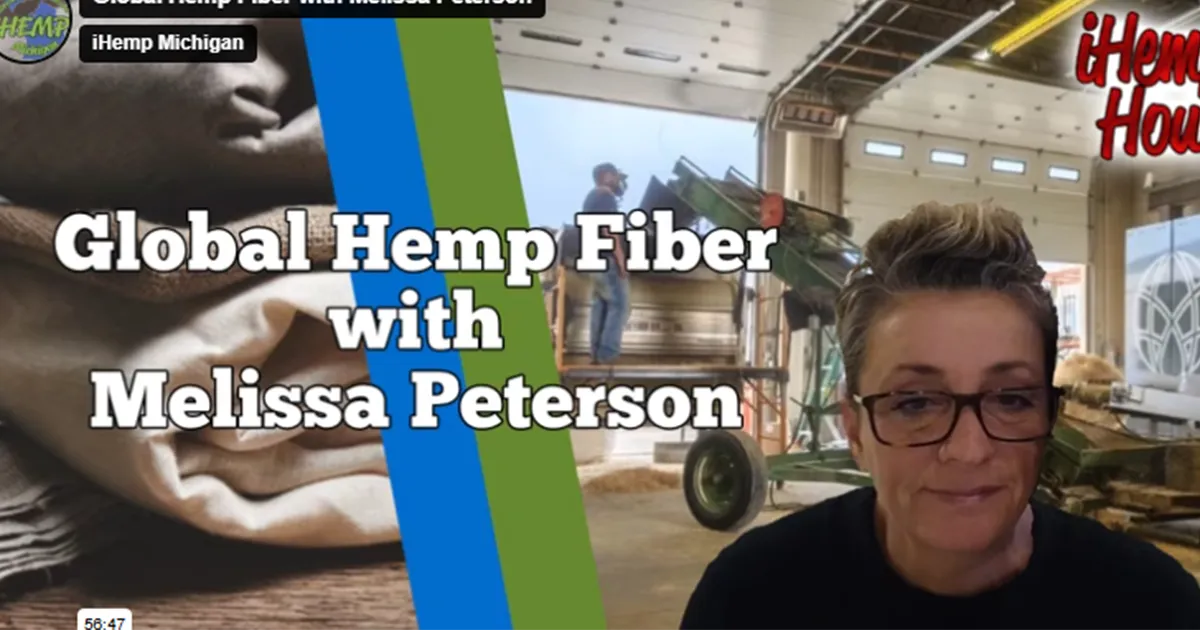
Melissa Peterson, co-founder of Global Fiber Processing in Colorado, joined the iHemp Hour fresh from speaking at Ascent Atlas’s Hemp Field Day in Michigan, where she shared hard-won lessons from building a regional decorticating facility from the ground up.
Rebuilding Trust After CBD’s Broken Promises
The conversation opened with a frank acknowledgment of the elephant in the room: many farmers remain skeptical of hemp after the CBD market’s collapse left growers holding worthless biomass and unfulfilled contracts.
“I don’t believe the CBD industry crashed. I just think there was a lot of farmers that went all in and grew way too much, and contracts were promised and people didn’t fulfill those.”
Peterson’s team has spent considerable time rebuilding relationships with farmers in Colorado’s San Luis Valley, where CBD operations previously dominated. The approach? Handshakes, transparency, and contracted off-take before a single seed goes in the ground.
“We’ve got contracts for all the off-take… We’re spending our time shaking hands and getting the farmers to understand the difference.”
The patience is paying off. Peterson reports that 2023 is shaping up to be a strong year for Colorado fiber production, with three major farming partners now under contract.
Seven Revenue Streams from a Single Stalk
One of the most compelling revelations from Peterson’s presentation: Global Fiber Processing has identified seven distinct end uses coming off their decorticating line—and every single one has active market demand.
Current product applications include:
|
Product |
Applications |
|
Long bast fiber |
Textiles (in R&D), industrial applications |
|
Short fiber |
Paper goods, insulation testing |
|
Clean hurd |
Animal bedding, building materials |
|
Micronized hurd |
Plastics compounding, specialty applications |
|
Building-grade hurd |
Hempcrete, construction |
|
Dust/fines |
Multiple uses (proprietary) |
|
Dual-purpose grain |
Food, feed applications |
“We obviously want to use the whole plant, but we weren’t 100% sure if we were going to be able to accomplish that. Every one of them is being requested—that was a very pleasant surprise.”
The animal bedding trials have proven particularly promising. Global Fiber is conducting controlled studies with a veterinarian and horse owners, rotating between hemp hurd bedding and traditional sawdust.
“The difference in how the animals are reacting is phenomenal. We’re excited to share those studies.”
The Numbers: What Regional Processing Actually Costs
For anyone considering establishing hemp fiber processing in their region, Peterson offered concrete figures based on Global Fiber’s experience:
Startup Investment: ~$2.5 Million
This includes:
- ✅ Complete decorticating machinery (Formation Ag equipment)
- ✅ Fiber cleaning systems (double fiber cleaners)
- ✅ Hurd sizing equipment (GCS and hammer mills)
- ✅ Bagging systems
- ✅ Insurance and OSHA compliance
- ✅ First-year operating costs
- ✅ Initial feedstock purchase
- ✅ Financial runway
The major variable? Facility costs—whether you own, buy, or rent the building.
Farmer Payment: ~$300/ton
Peterson emphasized this figure is Colorado-specific and reflects local input costs including irrigation water purchases:
“I want to make a really big point—I’m not saying this is what’s happening throughout the rest of the United States. Every area has very different issues.”
Expected Yields: 3-5 tons/acre
Global Fiber advises farmers to budget conservatively at three tons per acre, with genetics and farming practices potentially pushing yields to five tons.
The Machinery: What’s Actually Needed
For fiber processing focused on hurd products, the essential equipment includes:
- Decorticator – Separates fiber from hurd
- GCS (Gravity Cleaning System) – Initial cleaning
- Hammer mill – Sizing the hurd
- Bagging system – Packaging for market
For facilities processing fiber as well:
- Double fiber cleaners – Achieves 97-99% clean fiber on second pass
“Some processing facilities will only want to process the hurd… We’ve got our decortication system, double fiber cleaners, as well as the GCS and hammer mills.”
Genetics Matter: Finding the Right Varieties
Global Fiber has experimented with multiple hemp varieties for fiber production, with Gemma emerging as a current favorite:
“That runs through the system really well… It’s running really clean. We’re able to get that fiber on a second pass at about 99% clean.”
Peterson noted that their previous favorite, the A1 variety, is no longer available—a reminder that seed sourcing remains a challenge for fiber growers.
For fiber production, the goal isn’t maximum plant height:
“We grow for fiber, so we want our stalks a little thinner. We’re not going to go for the 16-foot plant—at least not right now.”
Seeding rates vary by variety, but Global Fiber targets approximately 1.2 million plants per acre for their fiber operations.
The Regional Model: Why 150 Miles Matters
Peterson repeatedly emphasized that regional processing infrastructure is essential for fiber economics to work:
“We believe in what we call the grain model. You need to be close to the farmers, closer to the manufacturers.”
The ideal radius? 150 miles from farm to processor.
“We’ve had to break that rule a little bit this year… but 150 miles is ideal.”
Transportation costs—particularly with current diesel prices—can quickly erode margins when hauling bulky hemp stalks across state lines. This reality drives Global Fiber’s expansion strategy: rather than scaling one massive facility, they’re planning regional processing hubs across the United States.
“Our goal is to set up these facilities throughout the United States… I could see Global Fiber being in four or five different places in the next year.”
Lessons Learned: Expect the Unexpected
Global Fiber opened its doors just 30 days before Peterson’s iHemp Hour appearance, and the journey from concept to operation taught hard lessons:
Electrical Infrastructure: After receiving quotes and completing layouts, they discovered the utility company didn’t have the required transformers in stock—facing a six-month delay.
“You gotta have Plan A, B, C, D, E, F, G. Every time we thought we were good, there was another completely unexpected problem.”
The solution required creative reconfiguration with their electrician and utility company. Peterson’s advice? Budget extra time for infrastructure surprises.
The Market Reality Check
When asked about pricing expectations from large buyers, Peterson delivered a sobering assessment:
“Some of the guys that have approached us want to buy somewhere between 18 and 25 cents a pound on unsized and clean hurd, and it’s not possible—at least not at this juncture.”
She called for industry-wide coordination on pricing:
“One of the things we really need to get on the same page with all the processors that are open in the US—we’ve got to get on the same page as far as what we’re able to do it for per pound. Manufacturers have to get a little bit more realistic too.”
Cross-Pollination Concerns: Separating Fact from Fiction
Peterson, who spent 15 years in the craft beverage industry dealing with similar specialty crop concerns, pushed back on marijuana growers’ complaints about hemp cross-pollination:
“The marijuana guys are saying that we’re growing ditch weed and we’re going to cross-pollinate their marijuana. It’s a very small percentage that’s going to happen. You more need to worry about pesticide drift.”
Her practical advice: Know your surroundings and take precautions—standard practice for any specialty crop operation.
In Michigan, where most commercial cannabis cultivation occurs indoors, the concern is largely moot.
From Craft Beverages to Craft Hemp
Peterson’s journey to hemp fiber began at the 2018 Wisconsin hemp conference, where attorney Courtney Moran announced the state’s hemp policy framework from her stage. What started as educational events quickly expanded to shows in New York, South Carolina, Las Vegas, Oregon, and Puerto Rico.
But her heart was always in fiber:
“I had a speaker say on one of my stages one time: ‘CBD is the one you take to the prom—it’s not the one you’ll marry.’”
Her mission now mirrors her work in craft beverages: protect farmers through regional education and prevent the mistakes that plagued early hemp adopters who bought seeds unsuited to their climate or crops without contracts.
Michigan News Briefs
🚨 Crime Lab Testing Controversy
Mike Brennan reported on a breaking story with major implications: The Michigan State Police Crime Lab has acknowledged that its THC testing methods may have been inaccurate, potentially affecting at least 3,250 cases since March 28, 2019.
The issue? People using legal CBD products may have tested positive for THC, leading to wrongful arrests, plea bargains, and even involvement in vehicular homicide cases and child protective services investigations.
Attorney General Dana Nessel has instructed all 83 county prosecutors to pause cases pending resolution. Cannabis attorneys believe the actual number of affected cases could be far higher.
📋 CRA Licensing Reminder
Hemp processors licensed through the Cannabis Regulatory Agency (CRA) should prepare for November renewal deadlines. Growers have additional time but should ensure all required reports are submitted.
🏆 Hemp Feed Coalition Elects New Leadership
- Andrew Bish (Hemp Harvest Works, Bish Enterprises) elected President
- Wendy Mosher (3rd Gen Genetics) elected Vice President
- Justin Swanson (Bose Public Affairs Group, Midwest Hemp Council) elected Secretary/Treasurer
Connect with Global Fiber Processing
📧 Email: melissa@globalfiberprocessing.com 🌐 Website: globalfiberprocessing.com 📞 Phone: 970-456-0728
Global Fiber Processing is actively seeking partners for regional facilities. If you have farmer networks, investor interest, or manufacturing connections in your state, reach out to explore partnership opportunities.
Recipe of the Week: Pineapple Grilled Salmon with Hemp Seeds
Blaine Bechtold shared this simple grilled fish recipe—perfect for the end of summer:
Ingredients:
- 4 salmon fillets (or any firm fish)
- Canned pineapple slices
- ¼ cup teriyaki sauce with honey
- 2 tablespoons hemp seeds
- Rice, salsa, and cilantro for serving
Quick Method: Place pineapple slices on the grill, top with fish, brush with teriyaki-honey glaze. Grill until fish is cooked through. Serve over 90-second rice with salsa and a generous sprinkle of hemp seeds.
Hemp seeds available at DownOnTheFarm.biz
Support Michigan Hemp
iHemp Michigan continues to advocate for common-sense hemp policy, farmer education, and regional infrastructure development. Whether you’re a farmer considering fiber production, an investor exploring processing opportunities, or a consumer seeking Michigan-made hemp products, there’s a place for you in this growing industry.
👉 Join today at iHempMichigan.com
Growing the future from seeds of the past.