2021 U.S. Hemp Production Report: $824 Million Industry Still Finding Its Footing
USDA data reveals the current state of American hemp—and why the future belongs to fiber and grain.
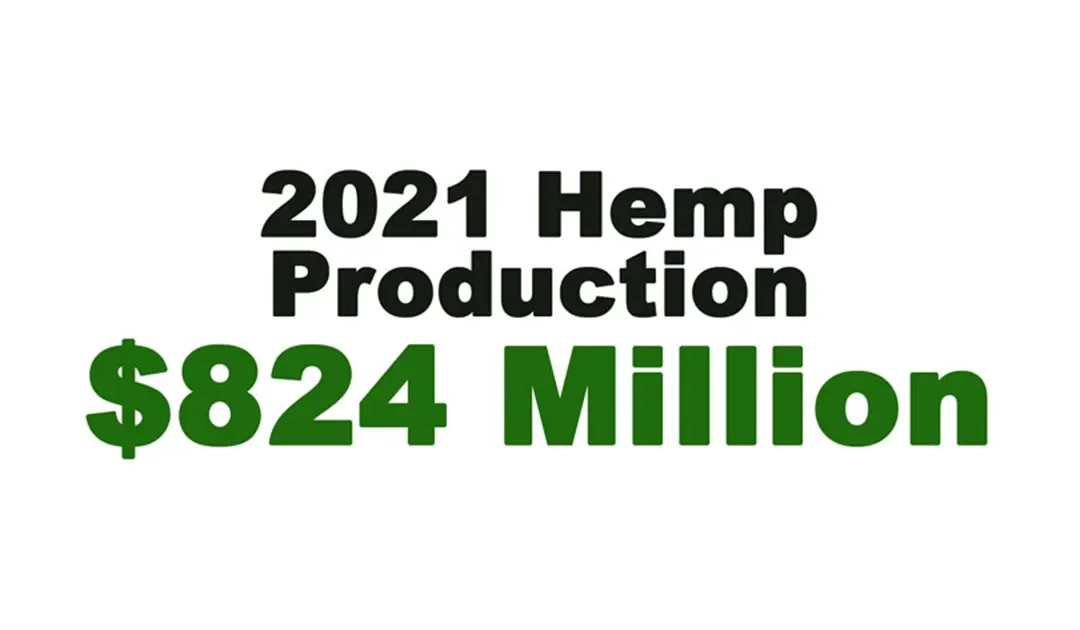
With mandatory reporting to the Farm Service Agency (FSA) now in place, we finally have reliable data on U.S. hemp production. The 2021 crop was valued at $824 million—a significant number, but still a far cry from where this industry needs to be.
The Numbers: 2021 U.S. Hemp Production at a Glance
|
Category |
Production |
|
Planted Acres |
54,152 |
|
Harvested Acres |
33,480 |
|
Floral Hemp (CBD) |
19.7 million pounds |
|
Hemp Fiber |
33.2 million pounds |
|
Hemp Grain |
4.37 million pounds |
|
Hemp Seed |
1.86 million pounds |
|
Grain Yield |
~530 lbs/acre |
A few things jump out immediately: only 62% of planted acres were actually harvested, suggesting continued challenges with crops going hot, market uncertainty, or cultivation difficulties. And while fiber tonnage looks impressive on paper, the infrastructure to process it remains a critical bottleneck.
CBD Still Dominates—But That’s Changing
Hemp grown for CBD and other cannabinoids continues to outpace fiber and grain production. This isn’t surprising given the higher per-acre returns that floral hemp can command and the relatively lower infrastructure requirements for extraction compared to fiber processing.
But this balance is shifting. Here’s why:
- Fiber Infrastructure Is Coming
Investment in decorticating facilities—both large centralized plants and mobile units—is accelerating. As processing capacity comes online, farmers will have reliable markets for fiber crops.
- Grain Markets Are Developing
Hemp hearts, hemp seed oil, and protein powder markets continue to grow. More importantly, the Hemp Feed Coalition is making progress toward approval for hemp grain and seed meal in livestock feed—a market that could dwarf current CBD demand.
- Regulatory Clarity Will Unlock Growth
Fair regulation allowing hemp grain for animal feed, clearer rules for CBD in food and supplements, and potential increases in THC limits will all reduce risk and encourage production expansion.
In future years, fiber and grain production will dwarf CBD and other cannabinoids. The economics simply make sense at scale—and American agriculture excels at scale.
The Yield Story: Where We Are vs. Where We Can Be
The current U.S. average grain yield of approximately 530 pounds per acre tells an important story—but it’s not the whole story.
A Lesson from Canada
On last night’s iHemp Hour, we interviewed Jeff Kostuik of Verve Seed Solutions. Jeff has been a longtime contributor to iHemp Michigan, having spoken at each of our Expos including our very first event at UM Flint in January 2019. At the time, Jeff was with Hemp Genetics International, which recently merged with Tritium (T3H) to form Verve Seed Solutions.
Jeff shared a critical insight: In the early days of growing grain in Canada, they produced similar yields of around 500 lbs per acre.
Today? Canadian farmers routinely achieve:
- 800-900 lbs/acre on average
- 1,000-1,500 lbs/acre for experienced growers
- Up to 2,000 lbs/acre in optimal conditions
That’s a 2-4x improvement over where American farmers are today—achieved through:
- Better variety selection matched to latitude
- Improved harvest techniques and equipment settings
- Understanding of optimal planting density and timing
- Experience with the crop’s unique characteristics
What This Means for U.S. Farmers
The 530 lbs/acre figure isn’t a ceiling—it’s a starting point. Canada’s 24-year head start in commercial hemp production shows us the trajectory. American farmers who invest time learning the crop now will be positioned to capture dramatically better yields as:
- Genetics improve – Hybrid varieties from companies like Verve Seed Solutions promise to double grain production within 2-3 years
- Knowledge spreads – Best practices for planting, cultivation, and harvest become better understood
- Equipment adapts – Combine settings and harvest timing get optimized for hemp’s unique characteristics
Jeff estimates it takes about three years for a farmer to really learn how to grow hemp well. The farmers starting now—while commodity prices for traditional crops provide a financial cushion—will have a significant advantage when hemp markets mature.
The Infrastructure Imperative
The gap between planted acres (54,152) and harvested acres (33,480) highlights a fundamental challenge: production without markets is just expensive gardening.
For hemp to reach its potential, we need:
Processing Capacity
- Decorticators for fiber separation (both centralized and mobile)
- Oil extraction facilities for grain processing
- Food-grade processing for hemp hearts and protein
Market Access
- FDA clarity on CBD in food and supplements
- Hemp feed approval for livestock (poultry expected first)
- Building code acceptance for hempcrete and insulation
Fair Regulation
- Reasonable THC limits (the push for 1% continues)
- Reduced testing burdens for grain and fiber crops
- Streamlined licensing to reduce farmer costs
Looking Ahead: The $824 Million Question
Is $824 million a success or a disappointment?
Both.
It’s a success because it represents a real, measurable industry that didn’t exist five years ago. Farmers are growing hemp. Processors are buying it. Products are reaching consumers. That’s remarkable progress.
It’s a disappointment because we know what this plant can do. Hemp can replace petroleum-based plastics. It can sequester carbon while producing building materials. It can provide complete protein for human and animal nutrition. It can remediate contaminated soils.
At scale, American hemp should be a multi-billion dollar industry. We’re not there yet.
But the trajectory is clear. The infrastructure is being built. The regulations are slowly improving. And farmers are getting smarter every season.
The Bottom Line
The 2021 USDA hemp report shows an industry in transition. CBD still leads, but fiber and grain are positioned for explosive growth as infrastructure and regulations catch up.
For farmers considering hemp: the learning curve is real, but the opportunity is too. Canadian growers went from 500 lbs/acre to 2,000 lbs/acre. American farmers can do the same—and the ones who start learning now will lead that charge.
As Jeff Kostuik reminded us: this is the year to throw some hemp into your rotation while strong commodity prices cushion the learning curve.
We will all be smarter next season.