Industrial Hemp Economics: Why Beau Whitney Is Still Bullish on Hemp’s Future
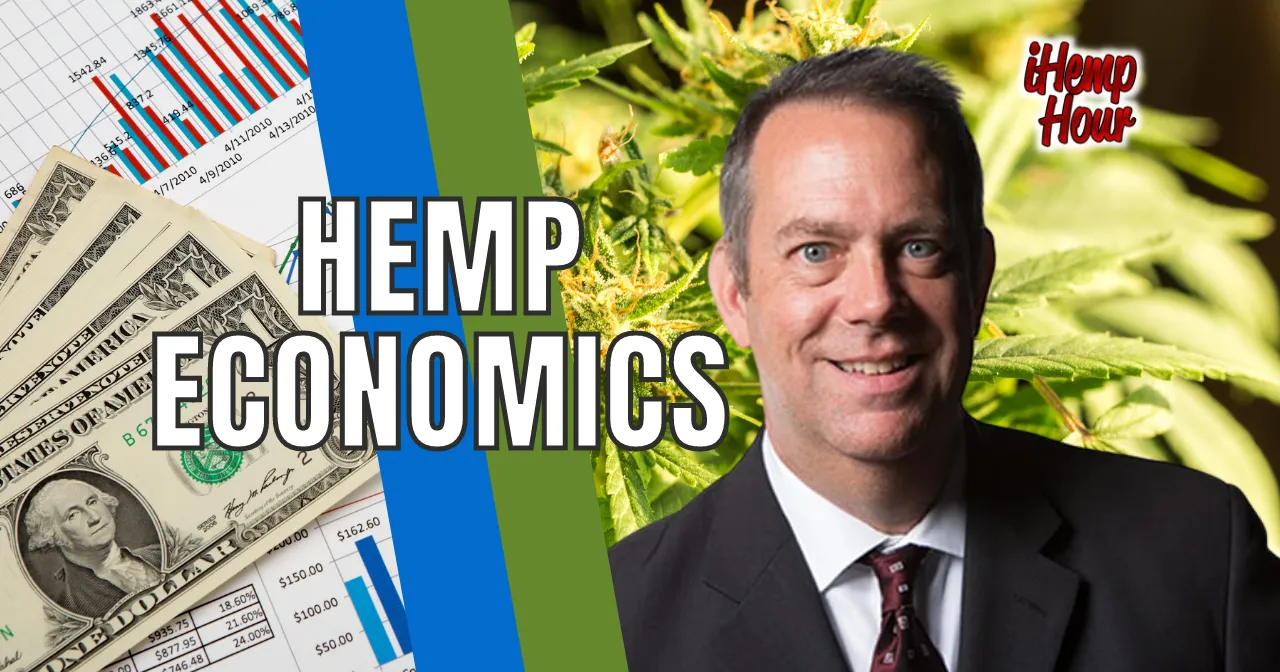
Featuring insights from Beau Whitney, Whitney Economics & National Industrial Hemp Council
Even after years of price crashes, regulatory confusion, and farmers getting burned by overpromises, economist Beau Whitney is still bullish on hemp.
Not in a hypey “get rich quick” way—but in a sober, data-driven, long-term way.
Whitney is the founder and chief economist at Whitney Economics, based in Portland, Oregon, and serves as Chief Economist for the National Industrial Hemp Council (NIHC). He’s surveyed thousands of hemp cultivators and processors, maps acreage and licensing data, and advises businesses and governments around the world on hemp and cannabis economics.
He joined us on the iHemp Hour to talk about where hemp really stands—and where it’s going.
From High-Tech Supply Chains to Hemp Fields
Beau didn’t start in agriculture. His background is in high-tech manufacturing, working for companies like Intel and TriQuint (now Qorvo), managing global supply chains.
Then, while teaching economics, a student brought up the cannabis industry. Beau started building demand models for Oregon’s adult-use market before legalization and quickly realized:
“There’s this huge opportunity.”
He jumped in, first on the cannabis side, and then at NOCO in 2017 he was asked to speak specifically on hemp economics. Once he dug into hemp, he concluded:
“This is going to make the marijuana market look small by comparison.”
Since then, he’s become one of the most widely cited hemp economists in the world, advising governments, trade associations, businesses, and investors—from Washington, D.C. to Victoria Falls, Zimbabwe.
The Current Reality: Painful, But Not Permanent
Let’s be honest: the last few years have been rough.
-
CBD biomass prices collapsed
-
Many farmers are sitting on unsold or “hot” inventory
-
Licensed acres in the U.S. have dropped more than 60% from the peak
-
Processors are operating below capacity—or have shut down entirely
Whitney has quantified that pain:
Heading into the 2021 season, he estimated over 200 million pounds (68,000+ tons) of excess hemp biomass sitting in inventory.
On top of that, about 25% of 2020 crops tested “hot” (over 0.3% THC), forcing destruction or extremely limited options.
No wonder a lot of farmers and processors feel burned and skeptical.
But Beau’s view? That’s only the first chapter.
Why He’s Bullish: 9–10 Million Acres by 2030
While licensed acres in 2021 and 2022 are way down from the highs, Beau believes that’s a temporary correction—not the end of the story.
His forecast: by around 2030, the U.S. could conservatively see:
9–10 million acres of hemp licensed.
Not 200,000 or 300,000 acres. Millions.
And here’s the key: that growth won’t be driven by CBD alone. It will be powered by fiber and grain for:
-
Animal bedding
-
Plastics and biocomposites
-
Construction materials like hempcrete and hemp wood
-
Textiles and technical fibers
-
Food and feed applications
While CBD may remain “the sexy part” of hemp, Whitney thinks grain and fiber will be the true transformation for agriculture and industry.
The Real Bottleneck: Product Manufacturing & Regulatory Fog
If demand is so promising, why aren’t we already there?
Beau points to two major choke points:
1. Product Manufacturing Gap
The hemp value chain looks like this:
Seeds → Propagation → Cultivation → Harvest → Processing → Product Manufacturing → Retail → Consumer
We’ve done a decent job at the beginning of that chain—lots of people can grow hemp, and many can process it into biomass, crude, isolates, hurd, or fiber.
But there’s a missing middle:
Product manufacturing—turning raw hemp materials into finished goods at scale.
Whether it’s hempcrete blocks, molded bioplastics, consistent animal bedding, textile yarn, or infused beverages, we simply don’t yet have enough companies and infrastructure converting hemp into high-volume finished products.
Without that, retailers don’t have reliable lines to sell—and investors hesitate, because they don’t see revenues flowing through the system.
2. Regulatory Murkiness
The second choke point is unclear federal rules, especially around:
-
CBD as a food or supplement (FDA inaction)
-
“Hot” hemp and THC thresholds
-
Interim THC levels during processing (when extracts can temporarily spike above 0.3%)
-
Animal feed approvals for hemp grain, cake, and byproducts
Whitney describes it as “regulation as control, not regulation as nurturing.” Instead of enabling responsible growth, current rules often paralyze farmers, processors, and product developers.
He also calls out the 0.3% THC line as a huge structural problem:
Go above 0.3% THC and you’re suddenly in “controlled substance” territory. Stay below and you’re a legal crop.
That bright line is strangling otherwise viable crops, especially when cannabinoids spike at harvest or during processing—often unintentionally.
Until regulators rethink how hemp is handled across different uses (fiber vs grain vs CBD), a lot of value will stay trapped.
Beau’s Regulatory Reset: Regulate by Use, Not Just at the Farm
One of Beau’s most important points is how we regulate hemp:
-
There should be crop-level regulation at the farm (for THC thresholds, environmental standards, etc.)
-
But beyond that, regulation should be tailored to the intended product
For example:
-
CBD tinctures and supplements should be regulated differently (like nutraceuticals or medicines)
-
Hemp fiber for car doors or plastics should be regulated like other industrial materials
-
Grain for food or feed should go through normal food/feed safety channels
Right now, we tend to start and stop the conversation at the farm gate and 0.3% THC, instead of building a full product-based framework.
Whitney argues for a “reset”:
Take a step back, look at the actual end uses, and design regulation that makes sense for each category—while still protecting consumers.
Global Competition: The U.S. Can’t Snooze on This
While the U.S. sorts out its rules, the rest of the world isn’t waiting.
Whitney points out:
-
Europe has a robust fiber and grain market, especially with low-THC genetics and industrial textiles
-
Asia (China, Laos, Cambodia, Vietnam) is actively expanding hemp fiber and textile production
-
Africa is in its early stages but moving
-
Canada has a mature grain and food hemp sector and has been shipping into U.S. markets for years
His concern:
If the U.S. drags its feet, we’ll end up importing products we could have produced here—and lose our chance to be competitive in a global hemp economy.
Hemp as a Rotational Cash Crop
From the farmer’s perspective, the most powerful economics may not be in replacing corn or soy, but in augmenting them.
Beau’s analysis shows that:
-
Hemp can be a revenue-positive rotational crop, not just a cover crop
-
It can help remediate soil and improve structure
-
When used as a dual crop (e.g., grain + fiber), profit per acre can rival or exceed traditional crops in some systems
He’s clear that hemp won’t “replace corn and soy” anytime soon—those are entrenched global commodities—but:
Hemp can become the fourth major crop in U.S. agriculture.
That’s a big statement—and it’s exactly why he projects millions of acres by 2030.
Demand Is Not the Problem
You sometimes hear critics say, “There’s more hemp being grown than there is demand.”
Whitney strongly disagrees.
In his surveys and work with brands, especially in food, beverage, and cosmetics, he’s seen:
-
CBD and hemp-infused cosmetic brands reporting 500–700% year-over-year growth, sustained over multiple years
-
Global interest in hemp textiles and technical fibers far outpacing current supply
-
Strong consumer appetite for sustainable, plant-based materials that reduce plastics and carbon footprints
His conclusion:
The demand is there. What’s missing is scaled product deployment and the infrastructure to serve that demand reliably.
The Path Forward: What Needs to Happen
So if Beau Whitney is right, what has to happen next?
1. Build Regional Processing & Product Hubs
States and regions need:
-
Decortication, drying, and storage facilities
-
Product manufacturing “campuses” where multiple end-users (plastics, building materials, textiles, feed) share feedstock
-
Support from state economic development offices and universities
We’re already seeing states like Colorado, Michigan, and others explore or invest in this kind of model.
2. Clarify Federal Rules
Congress and agencies like FDA and USDA need to:
-
Clarify CBD’s status in food and supplements
-
Approve hemp ingredients for animal feed (starting with poultry, where research is promising)
-
Modernize the THC threshold framework and differentiate crop regulation from product regulation
3. Standardize and Test
To unlock large-scale markets (construction, auto, plastics, textiles), we need:
-
Standards and certifications (ASTM, building codes, product specs)
-
Testing data for strength, safety, consistency
-
Clear pathways for hemp materials to be treated as equivalents to existing inputs
4. Educate & Organize
Beau also makes a political point: hemp has too many small associations and not enough unified voice.
To move policy:
-
Farmers, processors, and brands need to coordinate messaging
-
Industry groups need to present clear, data-backed asks to Congress and regulators
Why This Matters for Michigan & the Midwest
For Michigan and the Great Lakes region, all of this maps directly onto:
-
Our manufacturing heritage (plastics, autos, consumer products)
-
Our agricultural base
-
Our need for new, sustainable industries and rural economic development
Hemp can support:
-
Auto components and biocomposites
-
Building materials for cold climates (hempcrete, insulation, panels)
-
Animal bedding and feed (once approved)
-
Food products and wellness lines
-
New processing jobs in rural communities
As Beau said, the opportunities are there. The question is whether we build the infrastructure and regulatory framework fast enough to capture them.