
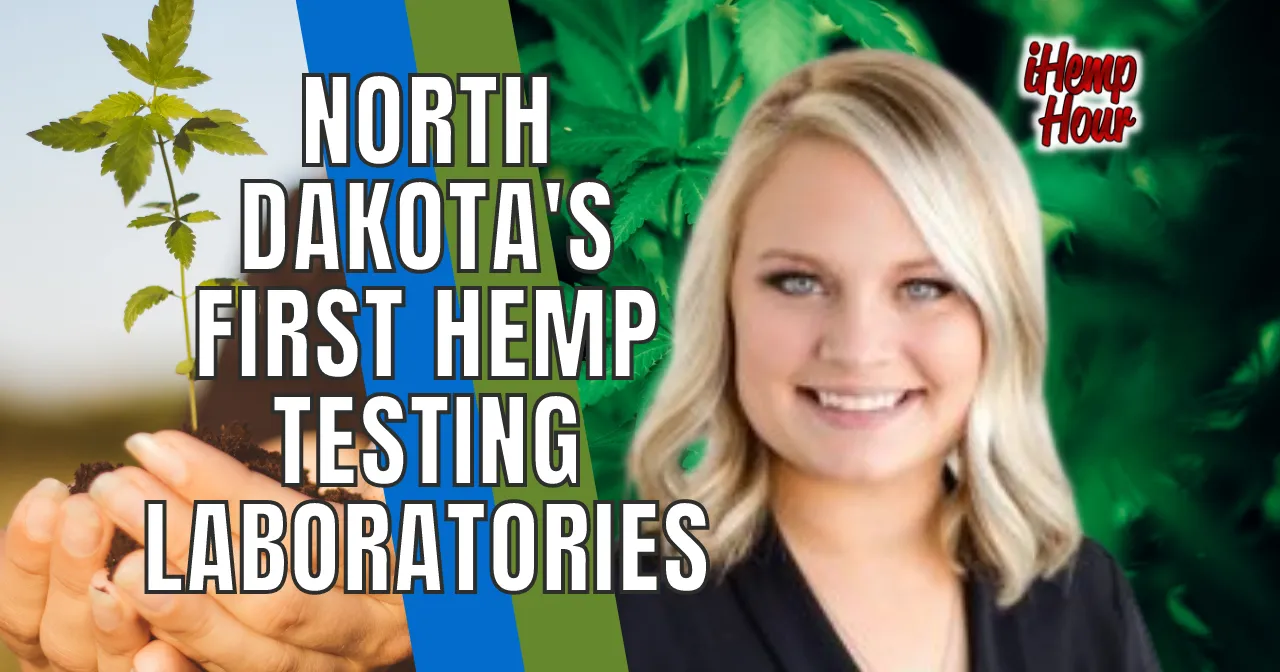
Understanding Hemp Testing with Precision: iHemp Hour Featuring Kia Mikesh of Adams Independent Testing
On this week’s episode of iHemp Hour, we were joined by Kia Mikesh, Vice President of Adams Independent Testing (AIT) in Fargo, North Dakota. AIT is one of the longest-standing third-generation grain inspection companies in the Midwest and one of the first hemp testing laboratories in the state. Kia brought a wealth of practical, trustworthy information on compliant testing, COAs, sampling, microbials, cannabinoids, and the evolving national standards that affect farmers, processors, and manufacturers.
If you want a stronger understanding of what a Certificate of Analysis should look like — and how to spot errors or red flags — this episode is a must-watch.
From Third-Generation Grain Inspectors to Trusted Hemp Testers
Kia grew up inside the family business. Now in its third generation, her family’s grain inspection laboratory has handled testing between buyers and sellers for over 50 years. When the 2018 Farm Bill opened the door for hemp production, the same farmers, processors, and customers who relied on the family’s grain expertise began asking:
“Can you test our hemp, too?”
The answer became Adams Independent Testing, a dedicated hemp testing laboratory built on three pillars:
1. Impartial, Conflict-Free Results
Because AIT does not own or hold financial interest in any hemp, marijuana, or cannabinoid business, they eliminate the most common source of industry bias. This is a major differentiator — especially in markets where labs are known to “guarantee” results or pad potency numbers to keep customers happy.
2. ISO 17025 Accreditation
AIT operates under international laboratory standards, ensuring:
-
Precision
-
Repeatability
-
Documented method validation
-
Use of certified reference materials
-
Transparent quality controls
3. Full-Service Testing for Hemp & CBD Products
AIT provides testing for:
-
Potency (THC, CBD, CBG, CBN, etc.)
-
Microbials (using PCR technology)
-
Mycotoxins
-
Heavy metals
-
Pesticides
-
Terpene profiles
-
Moisture/water activity
-
Product types: flower, biomass, extracts, distillates, gummies & edibles, tinctures, topicals, and more
Whether you’re a processor, formulator, grower, or buyer, AIT delivers fast, reliable, and defensible results.
Kia’s Deep Dive: How to Read a COA (Certificate of Analysis)
Kia walked through a sample COA step-by-step, highlighting what really matters — and what consumers and businesses often overlook.
Below is a breakdown of the essential elements of an accurate, trustworthy COA.
1. Look for: “Certificate of Analysis” at the top
It sounds simple, but many fraudulent COAs avoid stating this clearly.
2. Check Customer Details
A valid COA should show:
-
Who submitted the sample
-
A unique identifier (batch number, sample ID, or lot number)
-
Date received
-
Date tested
Red flag: A COA that is older than the actual product you’re buying.
3. Always Look for a Sample Photo
AIT includes sample photos for transparency.
Why it matters:
Some sellers test trimmed buds, then ship stems, leaves, or lower-quality biomass. The photo prevents this bait-and-switch.
4. Understand Total THC & Total CBD Calculations
AIT publishes the exact equation they use, which should match federal standards:
Total THC = (THCA × 0.877) + Δ9-THC
A COA without this equation is incomplete.
Kia noted that different labs sometimes use different math — creating confusion for farmers. Transparency matters.
5. Watch the LOQ (Limit of Quantitation)
This tells you the lowest measurable value the lab’s instruments can detect.
A deceptive lab might list “ND” (non-detect) because their detection limits are too high — not because the compound is truly absent.
Example:
Kia once saw a lab with a 1% detection limit for THC. That means the sample could be up to 0.99% THC, yet still be labeled “non-detect.”
Huge red flag.
6. Testing Panels: What’s Included
AIT’s full COAs typically include:
Potency
Full cannabinoid breakdown: CBD, CBDA, CBG, THCA, Δ9-THC, CBN, etc.
Terpenes
Kia demonstrated the terpene visualization chart — showing aroma profile categories such as:
-
Herbal
-
Citrus
-
Hoppy
-
Piney
-
Spicy
Terpenes are one of the fastest-growing tests for hemp flower branding and formulation.
Microbial Testing (PCR Method)
AIT uses Medicinal Genomics PCR technology — faster, more reliable, and more specific than old-fashioned petri dish tests.
Mycotoxins
Including aflatoxins and ochratoxin A. The COA displays the limit allowed and whether a result passes or fails.
Heavy Metals
Lead, cadmium, mercury, arsenic — all reported in parts per million.
Pesticides
Often 3–4 pages long. Failures are clearly marked across every page to prevent tampering at the PDF level.
How to Spot a Fraudulent COA (According to Kia)
Kia shared several real-world red flags:
🚩 Too-good-to-be-true numbers
Example: 17% CBD and “non-detect” THC on raw flower
→ usually impossible
🚩 No QR Code or a Fake QR Code
A valid QR code should link to a lab-hosted database, not a Dropbox file.
🚩 Missing photo, sample ID, or missing batch number
🚩 Outdated testing dates
🚩 Lab doesn’t list LOQs or measurement uncertainty
🚩 Lab does not participate in Emerald Scientific proficiency testing
AIT proudly displays their Emerald Test badges.
Proactive Testing: How Often Should Farmers Test?
Kia recommends:
-
Start testing early, especially with new genetics
-
Test every 1–2 weeks during flower
-
Test more frequently as harvest approaches
-
Never rely solely on state compliance testing
-
Grain and fiber varieties can absolutely go hot, despite common myths
Adams Independent Testing: Resources for the Industry
Kia shared excellent educational resources that AIT maintains:
✔️ Blog articles on:
-
How to sample hemp correctly
-
How to avoid sampling errors
-
Understanding COAs
-
Differences between tests
-
Proactive THC testing schedules
✔️ Full pricing published openly
Most labs hide their pricing. AIT posts it clearly at:
👉 HempInspection.com
✔️ Customer support for farmers & processors
They welcome questions and gladly walk through COAs.
How to Contact Adams Independent Testing
📍 Fargo, North Dakota
🌐 HempInspection.com
📧 AIT@hempinspection.com
📧 Kia directly: kia@hempinspection.com
Whether you’re a grower trying to stay compliant, a processor working on formulations, or a brand trying to verify your supply chain, AIT is one of the most trusted independent labs in the region.
Closing Thoughts
This was an incredibly educational episode for anyone who grows, processes, buys, or sells hemp. Kia and her family have built a rare resource in an industry that desperately needs transparency and integrity.
Understanding your COA isn’t just smart — it protects your business.
Thank you, Kia, for sharing your expertise with our community, and thank you to Adams Independent Testing for supporting iHemp Hour and helping strengthen our industry.